

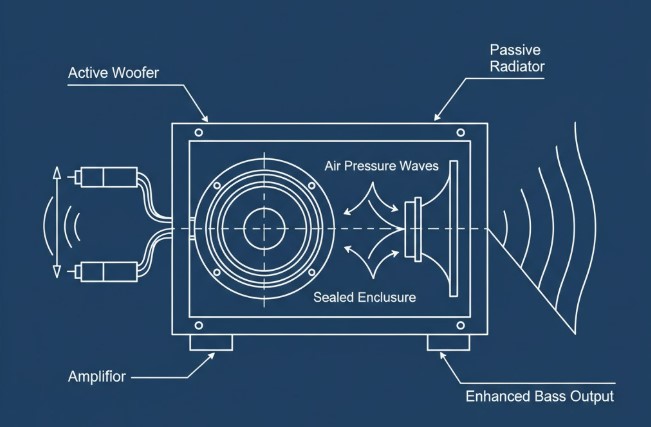
A passive radiator in speakers boosts bass response without needing a port. It’s an unpowered driver that vibrates with the air pressure from the active driver, enhancing low-frequency sound and allowing for smaller speaker designs.
Key Takeaways
- Enhances bass output in speakers.
- Improves sound quality without ports.
- Enables smaller speaker designs.
- Offers controlled bass response.
- Works using air pressure from an active driver.
- Reduces distortion at low frequencies.
What Does A Passive Radiator Do In Speakers?
Ever wondered why some speakers, especially smaller ones, can produce such deep, satisfying bass? You might be looking at a speaker system that uses a clever component called a passive radiator. If you’re curious about how these seemingly inert parts contribute to your favorite music or movie soundtracks, you’ve come to the right place. It can seem a bit technical, but understanding what a passive radiator does in speakers is simpler than you think. This guide will break it down for you, step-by-step, so you can appreciate the engineering behind great sound.
The Magic Behind Deep Bass: Understanding Speaker Components
Before we dive into passive radiators, let’s briefly touch on how speakers generally work. A speaker’s main job is to convert electrical signals into sound waves. The core component is the driver, which typically includes a cone, a voice coil, and a magnet. When electricity flows through the voice coil, it creates a magnetic field that interacts with the magnet, causing the coil and the attached cone to move back and forth. This movement pushes and pulls the air, creating the sound waves we hear.
For low frequencies, like the thump of a drum or the rumble of an explosion, speakers need to move a lot of air. This usually requires a larger driver and an enclosure that’s carefully designed to manage the sound produced by the back of the driver. Two common methods for enhancing bass are ported enclosures (also known as bass reflex) and sealed enclosures.
A sealed enclosure is airtight. It offers tight, accurate bass but often requires a larger speaker to achieve significant low-frequency output. A ported enclosure, on the other hand, has a hole or tube (port) that allows air to escape and enter the cabinet. This port is tuned to resonate at specific frequencies, amplifying the bass produced by the driver. Think of it like blowing over the top of a bottle to create a lower note; the air inside the bottle resonates.
Introducing The Passive Radiator: A Portless Wonder
So, what exactly is a passive radiator? In essence, it’s a speaker driver that looks and functions like a regular driver but has no voice coil or magnet attached. It’s essentially a cone, surround, and frame. Because it’s not powered, it doesn’t produce sound on its own. Instead, it’s strategically placed within a speaker enclosure to work in harmony with the main, active driver.
The primary purpose of a passive radiator is to enhance the bass output of a speaker system. It achieves this by resonating with the air pressure generated by the active driver. When the active driver moves backward, it creates a low-pressure area inside the enclosure. This causes the passive radiator to move inward. Conversely, when the active driver moves forward, it creates a high-pressure area, pushing the passive radiator outward.
This synchronized movement of the passive radiator effectively acts like a highly efficient port, but without the need for a physical opening in the speaker cabinet. This is where the “passive” aspect comes in – it’s powered by the air movement created by the active driver, not by an electrical signal.
How Does A Passive Radiator Work? The Science Explained
Let’s break down the physics a bit further. When the active driver in a speaker enclosure moves, it creates pressure waves inside the box. In a sealed enclosure, this air simply compresses and expands. In a ported enclosure, this air is channeled out through a port, which can be tuned to boost certain frequencies.
A passive radiator offers a different approach. Imagine a sealed box with two identical drivers. One is an active driver with a voice coil and magnet, and the other is a passive radiator with no electrical components. When the active driver pushes air out, it pressurizes the box. This pressure pushes the passive radiator outward.
When the active driver pulls air back in, it depressurizes the box. This creates a vacuum, causing the passive radiator to be pulled inward.
The key is that the passive radiator is designed to have a specific resonant frequency – the frequency at which it naturally wants to vibrate. By carefully matching the mass of the passive radiator to the volume of the enclosure and the characteristics of the active driver, designers can tune the system to resonate at low frequencies. This resonance allows the passive radiator to move a large volume of air, much like a tuned port, but with greater control and less turbulence.
This sympathetic vibration is incredibly effective. For a given enclosure size, a passive radiator can significantly boost the speaker’s ability to produce deep bass. It’s a way to get more “oomph” from a smaller package.
Passive Radiator vs. Ported Enclosures: A Comparison
Both passive radiators and ported enclosures are used to enhance bass response in speakers. However, they achieve this in different ways and have distinct advantages and disadvantages. Here’s a look at how they stack up:
| Feature | Passive Radiator Enclosure | Ported (Bass Reflex) Enclosure |
|---|---|---|
| Mechanism | Unpowered driver vibrates with air pressure. | Air tuned through a port to amplify bass. |
| Port Noise (Chuffing) | None. | Can occur at high volumes if the port is too small or not flared. |
| Low-Frequency Extension | Excellent, can achieve deep bass. | Good, but can be limited by port tuning. |
| Efficiency | High, can produce more bass with less power. | High, can produce more bass with less power. |
| Distortion | Generally lower distortion at very low frequencies. | Can experience higher distortion and “chuffing” noise. |
| Enclosure Size | Can allow for smaller enclosures for a given bass output. | Requires careful port tuning and can sometimes be larger. |
| Complexity | Requires careful matching of passive radiator mass and enclosure volume. | Requires precise port length and diameter calculation. |
As you can see, both methods have their strengths. Passive radiators are often favored for their ability to deliver deep, clean bass without the potential for port noise. They also enable manufacturers to create more compact speaker designs that still deliver a powerful low-end punch. For instance, many soundbars and compact bookshelf speakers use passive radiators to compensate for their small size.
Key Benefits of Using Passive Radiators
The use of passive radiators in speaker design isn’t just a marketing gimmick; it offers tangible benefits for both the manufacturer and the listener:
- Enhanced Bass Output: This is the primary advantage. Passive radiators allow speakers to produce deeper and more impactful bass frequencies than they would otherwise be capable of, especially in smaller enclosures.
- Smaller Enclosure Size: To achieve the same level of bass as a ported or passive radiator design, a sealed enclosure typically needs to be much larger. Passive radiators enable more compact speaker designs without sacrificing bass performance. This is crucial for home theaters, modern living spaces, and portable audio devices.
- Reduced Distortion: Unlike ported systems, passive radiators don’t suffer from “port chuffing” or air turbulence noise at high volumes. This can lead to cleaner, more accurate bass reproduction, particularly at higher listening levels.
- Tuned Bass Response: The mass of the passive radiator and the volume of the enclosure can be precisely tuned to achieve a specific bass character. This gives audio engineers more control over the speaker’s low-frequency output, allowing for a more refined sound.
- Improved Efficiency: By effectively coupling the air movement from the active driver to the outside, passive radiators can make the speaker system more efficient, meaning it can produce more volume with less amplifier power.
- No Air Turbulence Noise: Traditional ports can sometimes create “chuffing” or whistling sounds as air is forced in and out at high velocities. Passive radiators, by their design, eliminate this issue entirely.
These benefits make passive radiators a popular choice for a wide range of audio equipment, from high-end subwoofers to everyday Bluetooth speakers.
Passive Radiator vs. Active Radiator: What’s the Difference?
It’s important to clarify the terminology. When we talk about a passive radiator, we are referring to the unpowered driver. The term “active radiator” isn’t a standard term in speaker design; however, it’s implied that the “active driver” is the powered component that moves air and causes the passive radiator to vibrate.
Here’s a simple breakdown:
- Active Driver: This is the standard speaker driver with a voice coil and magnet. It receives the electrical signal and moves to create sound waves. It’s the engine of the speaker.
- Passive Radiator: This is a driver without electrical components. It’s essentially a weighted cone attached to a surround and frame. It’s moved by the air pressure changes created by the active driver and serves to reinforce bass frequencies. It’s the assistant that amplifies the bass.
Think of it like a dueling piano act. One pianist (the active driver) is playing the main tune. The other pianist (the passive radiator) is playing along, adding depth and resonance, but only because they’re mirroring the first pianist’s movements and energy. They aren’t playing their own independent tune.
Where You’ll Find Passive Radiators
Passive radiators are incredibly versatile and can be found in a surprisingly wide array of audio devices. Their ability to enhance bass in compact designs makes them ideal for:
- Bookshelf Speakers: Many smaller bookshelf speakers use passive radiators to compensate for their limited cabinet volume, delivering a fuller bass response than would otherwise be possible.
- Soundbars: To achieve decent bass from a slim form factor, soundbars frequently incorporate passive radiators.
- Computer Speakers: Compact desktop speaker systems often use passive radiators to boost their low-end punch.
- Portable Bluetooth Speakers: The need for loud, bass-heavy sound from small, battery-powered devices makes passive radiators a popular choice.
- Subwoofers: While many subwoofers use large active drivers and ported designs, passive radiators are also used in some subwoofer designs, particularly those aiming for very deep, tight bass in a specific enclosure size.
- Home Theater Systems: Some compact satellite speakers for surround sound systems might employ passive radiators to ensure they can reproduce low-frequency effects convincingly.
You might even see them on some premium car audio systems or high-end headphones designed for a more immersive experience.
How to Identify a Passive Radiator
Spotting a passive radiator isn’t always obvious at first glance, as they look very similar to active drivers. However, there are a few clues:
- Look for a Pair: Often, a speaker with a passive radiator will also have an active driver of the same or similar size. The passive radiator might be located on the front, back, or sides of the speaker.
- No Visible Wires or Terminals: Unlike an active driver, a passive radiator won’t have visible wires connecting it to the speaker’s internal crossover or amplifier. It will look like a bare cone and surround.
- Manufacturer Specifications: The most reliable way to know is to check the product specifications. Manufacturers will usually highlight the use of passive radiators, often marketing it as a feature for enhanced bass.
- Feel for Movement: If you can safely (and without damaging the speaker) touch the cone of a driver while music is playing at a moderate volume, you can feel if a driver is vibrating. If a driver is vibrating significantly and doesn’t have visible wires, it’s likely a passive radiator.
Sometimes, manufacturers will explicitly label the passive radiator on their product pages or in the manual. For example, a speaker might list “1 x 6.5-inch woofer” and “1 x 6.5-inch passive radiator” in its specifications.
Passive Radiator Maintenance
One of the great advantages of passive radiators is their simplicity. Since they have no electrical components, there’s very little that can go wrong with them. Unlike a port, there’s nothing to get clogged or blocked. The main concerns are:
- Physical Damage: The cone of a passive radiator is exposed, just like an active driver. Care should be taken to avoid puncturing or tearing the cone, as this would render it ineffective and likely produce undesirable rattling sounds.
- Surround Degradation: Over long periods, the rubber or foam surround that connects the cone to the frame can degrade, especially if exposed to extreme temperatures or UV light. If the surround cracks or deteriorates, the radiator will not move freely and will likely create buzzing sounds.
- Dust and Debris: While less of an issue than with ports, significant amounts of dust or debris can accumulate on the cone, potentially affecting its movement slightly. Regular dusting with a soft brush is usually sufficient.
For the most part, passive radiators are a low-maintenance component. If you notice rattling from a driver that appears to be a passive radiator, it’s usually a sign that the surround has failed or the cone has been damaged.
Pro Tips for Maximizing Your Speaker’s Bass
Whether your speakers use passive radiators, ports, or are sealed, here are some tips to get the best bass performance:
- Placement Matters: Placing your speakers near a wall or in a corner can naturally boost bass frequencies due to acoustic reinforcement. Experiment with different positions.
- Experiment with Speaker Height: Sometimes, even a slight change in speaker height can alter how bass frequencies interact with your room.
- Consider Room Acoustics: Hard surfaces reflect sound, while soft surfaces absorb it. Large, empty rooms often sound bass-light. Adding rugs, curtains, or upholstered furniture can help balance the sound.
- Equalization (EQ): Many amplifiers and digital audio players have EQ settings. You can use these to slightly boost bass frequencies if your speakers lack sufficient low end. Be cautious, as over-boosting can lead to distortion.
- Check Connections: Ensure all speaker cables are securely connected and that you’re using a decent gauge wire for your speakers. Loose connections can rob you of bass.
- Use a Subwoofer: If your main speakers, regardless of their design, still don’t deliver the bass you desire, adding a dedicated subwoofer is the most effective solution.
Understanding how your speaker’s components work, like passive radiators, can help you make informed decisions about placement and system upgrades.
Frequently Asked Questions (FAQ)
Q1: Are speakers with passive radiators better than ported speakers?
Not necessarily better, but they offer different advantages. Passive radiators excel at providing deep, clean bass in compact designs without port noise. Ported speakers can also achieve great bass but might be susceptible to port noise and require careful port tuning.
Q2: Can a passive radiator be damaged?
Yes, a passive radiator can be damaged if its cone is punctured or if the surround (the flexible material connecting the cone to the frame) degrades over time, leading to tears or cracks.
Q3: How do I know if my speaker has a passive radiator?
Look for a driver on the speaker that looks like a regular speaker cone but has no visible wires or terminals. Often, it will be paired with an active driver of a similar size. Checking the product specifications is the most accurate way.
Q4: Do passive radiators require power?
No, passive radiators are unpowered. They vibrate as a result of the air pressure changes created by the active driver inside the speaker enclosure.
Q5: Can I replace a damaged passive radiator myself?
Repairing or replacing a passive radiator can be done, but it requires specific parts and care. The mass of the radiator cone is critical to its tuning. If the surround is damaged, it might be possible to repair it, or you may need to replace the entire radiator unit with one of the exact specifications.
Q6: Will a passive radiator make my speakers louder?
While they don’t directly increase volume, passive radiators improve bass efficiency. This means the speaker can produce more low-frequency output for a given amount of power, making the overall sound feel more robust and impactful, especially in the bass frequencies.
Conclusion: The Power of the Unseen
Passive radiators are a testament to ingenious audio engineering. By harnessing the physics of air pressure and resonance, they allow smaller, more aesthetically pleasing speakers to deliver surprisingly powerful and deep bass. They solve the common dilemma of wanting rich low-end sound without the bulk of traditional speaker designs or the potential drawbacks of ported enclosures.
Next time you encounter a compact speaker with impressive bass, take a closer look. You might just discover the quiet, unseen workhorse – the passive radiator – playing its vital role in bringing your audio to life. Understanding this component not only demystifies a piece of technology but also allows you to better appreciate the design choices that go into creating the sounds you love.
