

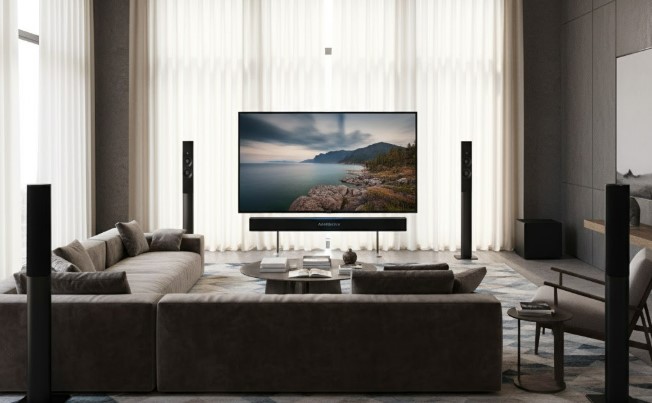
Finding the best soundbars for large rooms with high ceilings is crucial for immersive audio. Look for powerful soundbars with strong bass, wide soundstages, and virtual surround sound features to fill expansive spaces effectively.
Key Takeaways
- Choose powerful soundbars for spacious rooms.
- Prioritize wide soundstages and deep bass.
- Look for virtual surround sound options.
- Consider dedicated subwoofers for better low-end.
- Ensure sufficient volume for high ceilings.
- Check connectivity for easy setup.
Why Your Large Room Needs a Special Soundbar
You’ve got the spacious living area, the soaring ceilings that make a statement, and maybe even a massive TV. But when it comes to movie nights or listening to your favorite music, are you getting the audio experience you deserve? Often, standard soundbars struggle to fill large rooms. The sound can feel weak, distant, or simply not immersive enough, especially with those high ceilings that tend to scatter sound. This is where choosing the best soundbars for large rooms with high ceilings becomes really important. Don’t worry, though! This guide will break down exactly what you need to look for, making it simple to pick a soundbar that will transform your audio experience.
Understanding Sound for Large Spaces
Large rooms, especially those with high ceilings, present unique acoustic challenges. Sound waves have more space to travel, and high ceilings can cause sound to dissipate or reflect in ways that muddy the audio. Unlike smaller rooms where sound can bounce around and fill the space more readily, large areas need sound systems that can project audio clearly and powerfully across a wider area.
Think of it like trying to whisper across a football field versus across a small table. You need more power and direction to be heard clearly in the larger space. For soundbars, this translates to needing drivers that can produce a substantial volume, a wide soundstage to create an immersive feel, and technologies that help direct sound effectively.
Key Features for Soundbars in Large Rooms
When you’re shopping, keep these crucial features in mind. They are designed to overcome the acoustic challenges of expansive rooms.
1. Power and Volume Output (Watts)
This is perhaps the most straightforward factor. More watts generally mean more power, which allows the soundbar to fill a larger space without distortion. For large rooms, aim for soundbars with at least 100 watts, and ideally, much more, especially if you enjoy listening at higher volumes. Some higher-end models can reach several hundred watts.
A good indicator is the total system wattage. Soundbars often list the wattage of the main bar and any included wireless subwoofer separately. Adding these up gives you a better idea of the overall power.
2. Soundstage Width
A wide soundstage makes the audio feel expansive, enveloping you in sound rather than just coming from a single point in front of you. Look for soundbars that are physically wider, as this can contribute to a broader soundstage. Features like dedicated side-firing or up-firing speakers in some models also help create a more immersive, room-filling sound.
Some technologies, like Dolby Atmos or DTS:X, use clever processing to simulate sound coming from all around you, even without physical rear speakers. This is a huge plus for large rooms.
3. Bass Response and Subwoofers
Deep, impactful bass is essential for movies and music. In large rooms, a weak bass can make the audio feel thin. Most soundbars come with at least a small integrated subwoofer or are designed to pair with an external one. For spacious rooms, a dedicated wireless subwoofer is highly recommended. These external units are larger and can produce much more powerful and resonant bass frequencies that can truly fill your room.
Consider the size of the driver in the subwoofer. Larger drivers generally produce deeper and more powerful bass. Look for subwoofers that are at least 8 inches in diameter, with 10 inches or larger being even better for substantial bass.
4. Virtual Surround Sound Technologies
Achieving true surround sound in a large room with just a soundbar and no rear speakers can be challenging. This is where virtual surround sound technologies shine. Features like Dolby Virtual:X, DTS Virtual:X, and proprietary technologies from brands like Samsung (e.g., Q-Symphony) use advanced processing to create the illusion of sound coming from multiple directions. This helps to bounce sound off walls and ceilings, mimicking a more immersive surround experience without the need for extra speakers and complex wiring.
While not a replacement for a true surround sound system, these technologies are incredibly effective at making the audio feel more spacious and engaging in large, open areas.
5. Connectivity Options
Ensure the soundbar has the ports you need. HDMI ARC (Audio Return Channel) or eARC (enhanced Audio Return Channel) is essential for connecting to your TV with a single cable, allowing audio to flow back to the soundbar. More HDMI inputs are useful if you plan to connect gaming consoles, Blu-ray players, or streaming devices directly to the soundbar. Wireless connectivity like Bluetooth and Wi-Fi is also standard for streaming music from your phone or other devices.
Top Soundbar Categories for Large Rooms
Not all soundbars are created equal, and some are better suited for larger spaces than others. Here’s a look at the common categories and what they offer:
| Soundbar Type | Pros for Large Rooms | Cons for Large Rooms |
|---|---|---|
| Basic/Compact Soundbars | Affordable, simple to set up. | Often lack power, narrow soundstage, weak bass. |
| Mid-Range Soundbars with Subwoofers | Good balance of price and performance, improved bass, wider sound. | Virtual surround may be less convincing than higher-end models. |
| Premium Soundbars (with or without wireless surrounds) | Powerful, wide soundstage, advanced virtual surround, excellent bass. | Higher cost, may require more complex setup. |
| Soundbars with Dolby Atmos/DTS:X | Immersive 3D audio, excellent for creating height and depth. | Requires careful placement for best effect, often higher price. |
Evaluating Soundbars: What to Look For (and What to Avoid)
When you’re comparing different models, keep this checklist handy. It will help you make an informed decision.
What to Look For:
- Clear specifications on power output (total wattage).
- Physical width of the soundbar – wider often means a wider soundstage.
- Dedicated external subwoofer included or as an option.
- Support for Dolby Atmos or DTS:X for immersive audio.
- Positive reviews specifically mentioning performance in large rooms.
- Bluetooth and Wi-Fi connectivity for streaming.
What to Avoid:
- Soundbars with very low wattage (e.g., under 50W total).
- Models without any mention of bass enhancement or subwoofer support.
- Soundbars marketed solely for small apartments or bedrooms.
- Audio-only reviews that don’t mention room size or soundstage.
Recommended Soundbars for Large Rooms with High Ceilings
While brands and models change, certain types of soundbars consistently perform well in larger spaces. Here are a few examples of what to look for, based on features that make them suitable for your needs:
1. High-Powered All-in-One Systems
These soundbars are designed with robust internal amplifiers and multiple drivers to project sound powerfully. They often feature technologies to widen the soundstage, making them a great starting point for large rooms.
Look for: Models from major brands known for their audio technology, often with at least 200W of total power. Many of these will have good built-in virtual surround sound capabilities.
2. Soundbar Systems with Wireless Subwoofers
This is often the sweet spot for value and performance in large rooms. The separate subwoofer handles the low-frequency effects (LFE) that are crucial for movie soundtracks and bass-heavy music. The main soundbar can then focus on mid and high frequencies, creating a more balanced and impactful sound.
Look for: Systems where the subwoofer is a significant size (e.g., 10 inches or more) and the soundbar itself has a decent width. Brands like Samsung, LG, and Vizio offer excellent options in this category.
3. Dolby Atmos/DTS:X Enabled Soundbars
For the most immersive experience, soundbars that support Dolby Atmos or DTS:X are top contenders. These formats use object-based audio to create a three-dimensional soundscape, including height effects. In a room with high ceilings, up-firing speakers in the soundbar or dedicated upward-firing modules can bounce sound off your ceiling to create overhead audio effects. This can significantly enhance the feeling of immersion.
Look for: Soundbars that explicitly mention Dolby Atmos or DTS:X support. Some of the best ones also come with wireless rear speakers for an even more complete surround experience, though these can be more complex to set up.
For example, the Samsung HW-Q800C, a popular model featuring Dolby Atmos and a dedicated subwoofer, is often praised for its ability to fill a room with sound. Similarly, systems from brands like Sonos and Bose offer excellent audio quality and room-filling sound, with some models specifically designed to adapt to their environment.
Setting Up Your Soundbar for Optimal Performance
Once you’ve purchased your soundbar, proper setup is key to maximizing its potential in your large room.
1. Placement is Crucial
For the soundbar: Position it directly in front of your TV, ideally at ear level. If it’s too low or too high, the sound can be directed away from you. For soundbars with up-firing speakers (for Atmos), ensure there are no obstructions directly above it, and that your ceiling is not excessively angled or made of highly absorbent material.
For the subwoofer: Subwoofer placement has a big impact on bass. The “subwoofer crawl” is a good technique: place the subwoofer in its intended listening position and play some bass-heavy music. Then, crawl around the room at ear level and find where the bass sounds best. That’s where you should place your subwoofer. Corners can sometimes boost bass but can also make it boomy; experiment to find the sweet spot.
2. Connect and Configure
Use an HDMI ARC/eARC connection to your TV whenever possible. This ensures the best audio quality and allows your TV remote to control the soundbar’s volume. If your TV or soundbar doesn’t support ARC, you might need to use an optical cable, but this limits audio format support.
Follow the manufacturer’s instructions for pairing any wireless subwoofers or rear speakers. Most modern systems are designed to pair automatically or with a simple button press.
3. Calibrate the Sound
Many premium soundbars come with an automatic calibration system. This often involves placing a microphone (usually included) at your main listening position. The soundbar then plays test tones and adjusts its output to compensate for your room’s acoustics. If your soundbar has this feature, use it! It’s especially helpful in large rooms with unpredictable sound reflections.
If manual calibration is an option, look for settings like “bass boost,” “surround effect,” or “dialogue enhancement” and adjust them to your preference. Start with the defaults and tweak from there.
Pro Tip: Many soundbars have a “night mode” or “dialogue clarity” setting. This can be very useful in large rooms where you might not want to blast the volume but still need to hear dialogue clearly over background music or ambient noise.
Frequently Asked Questions (FAQ)
Q1: Do high ceilings affect soundbar performance?
Yes, high ceilings can cause sound to spread out more, potentially reducing clarity and impact. Sound waves may reflect off them in ways that diminish the direct sound. Soundbars designed for large rooms with features like higher power output and virtual surround sound help overcome this.
Q2: How important is a separate subwoofer for a large room?
A separate subwoofer is highly recommended for large rooms. It provides the deep, powerful bass needed to fill the space effectively, which a small, integrated subwoofer in a soundbar often can’t achieve on its own. This makes movies and music feel much more impactful.
Q3: Can a soundbar really fill a very large living room?
A high-quality soundbar with sufficient power, a wide soundstage, and a good subwoofer can definitely fill a large living room. Soundbars with Dolby Atmos or DTS:X can also create a more immersive experience by simulating overhead and surround sounds, making the audio feel more expansive and engaging.
Q4: What is virtual surround sound, and is it good for large rooms?
Virtual surround sound uses processing to simulate audio coming from different directions (front, side, rear, and sometimes overhead) without needing physical speakers. It’s very effective in large rooms where running speaker wires can be difficult, helping to create a more immersive and room-filling audio experience.
Q5: How do I know if a soundbar is powerful enough for my large room?
Look at the total wattage rating. For a large room, aim for at least 100-200 watts total system power, with more being better for very large spaces or if you like to listen loudly. Reviews that mention performance in large rooms are also a good indicator.
Q6: Should I get a soundbar with up-firing speakers for high ceilings?
Up-firing speakers can be beneficial if your ceilings are flat and not too high (typically 8-10 feet). They bounce sound off the ceiling to create height effects. However, very high or angled ceilings might not reflect sound optimally, so check reviews and consider if this feature is worth the extra cost for your specific room.
Conclusion
Choosing the best soundbars for large rooms with high ceilings doesn’t have to be complicated. By focusing on key features like power output, soundstage width, bass capabilities, and virtual surround sound technologies, you can find a system that truly transforms your audio experience. Remember that a powerful soundbar paired with a capable subwoofer is your best bet for overcoming the acoustic challenges of spacious environments. With the right setup and configuration, you’ll be enjoying a rich, immersive, and room-filling sound for all your entertainment needs.
