

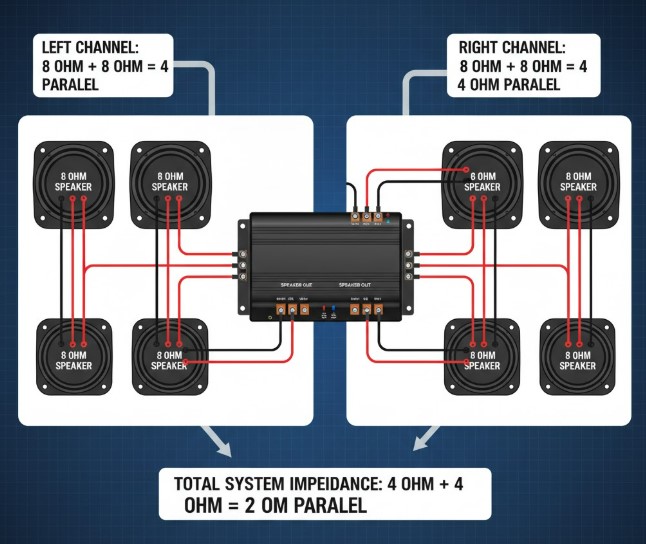
This 8 Ohm To 2 Ohm Speaker Wiring Guide simplifies converting your speaker setup. Learn essential wiring techniques to safely connect 8-ohm speakers to 2-ohm systems without damaging your amplifier. Follow our step-by-step instructions for a confident DIY audio upgrade.
Key Takeaways
- Understand speaker impedance and its importance.
- Wire 8-ohm speakers in parallel for 2-ohm systems.
- Learn how series wiring differs and why it’s not ideal here.
- Ensure your amplifier can handle the lower impedance.
- Safely connect your speakers for optimal sound.
Introduction
Are you looking to upgrade your car or home audio system and wondering how to connect your existing 8-ohm speakers to a new amplifier that requires a 2-ohm load? It’s a common question, and frankly, it can sound a bit confusing at first glance. Many beginners worry about damaging their expensive audio equipment. But don’t worry! This guide is designed to break down the process of 8 ohm to 2 ohm speaker wiring in a way that’s easy to understand and implement. We’ll walk you through the principles and provide a clear, step-by-step approach so you can confidently make the right connections.
Understanding Speaker Impedance (Ohms)
Before we dive into wiring, let’s quickly cover what “ohms” actually mean in the world of speakers. Impedance, measured in ohms (Ω), is essentially the resistance a speaker offers to the electrical current flowing from your amplifier. Think of it like the water pressure in a pipe; a lower ohm rating means the speaker “pulls” more current from the amplifier, while a higher ohm rating means it pulls less.
Amplifiers are designed to work with a specific range of impedance. If you connect speakers with an impedance that’s too low for the amplifier, it can force the amplifier to work harder than it’s designed for. This can lead to overheating and, in worst-case scenarios, permanent damage to the amplifier. Conversely, if the impedance is too high, the amplifier might not be able to push enough power to the speakers, resulting in lower volume and less robust sound.
Most home audio amplifiers are designed for 8-ohm speakers, which are very common. However, some powerful car audio amplifiers and certain subwoofer systems are designed for 4-ohm or even 2-ohm loads. This is where the challenge of 8 ohm to 2 ohm speaker wiring comes in.
Why You Can’t Directly Connect 8 Ohm Speakers to a 2 Ohm System
As we touched on, directly connecting an 8-ohm speaker to an amplifier designed for a 2-ohm load isn’t a good idea. The amplifier expects to see a significant current draw (at 2 ohms). An 8-ohm speaker, by its nature, will draw much less current. This mismatch means you won’t get the performance you expect, and importantly, it’s not the scenario where you’d typically damage the amp by underloading it. The real danger comes when you try to drive a lower impedance speaker (like a 2-ohm speaker) on an amp rated for higher impedance (like 8 ohms), or worse, connecting multiple higher impedance speakers in a way that results in an overall lower impedance than the amp can handle.
The question of 8 ohm to 2 ohm speaker wiring usually arises when someone wants to use their existing 8-ohm speakers with a new amplifier that needs a 2-ohm load, or perhaps wants to expand a system. The key to achieving the desired 2-ohm load is how you wire multiple speakers together. It’s not about changing the inherent impedance of a single 8-ohm speaker, but rather about combining them in a specific configuration.
The Magic of Wiring: Series vs. Parallel
When you connect multiple speakers, you can do so in two main ways: series or parallel. The way you connect them dramatically changes the total impedance your amplifier “sees.” Understanding this is crucial for successful 8 ohm to 2 ohm speaker wiring.
Series Wiring
In a series connection, speakers are wired one after another, like links in a chain. The positive terminal of one speaker connects to the negative terminal of the next, and so on. The amplifier’s positive wire connects to the start of the chain, and the amplifier’s negative wire connects to the end of the chain.
- How it affects impedance: When you wire speakers in series, their impedances add up.
- Formula: Total Impedance (Ztotal) = Z1 + Z2 + … + Zn
- Example: Two 8-ohm speakers wired in series will present a total impedance of 8Ω + 8Ω = 16Ω to the amplifier.
- When to use it: Series wiring is generally used when you need to increase the total impedance to match an amplifier that requires a higher load. This is the opposite of what we need for 8 ohm to 2 ohm speaker wiring.
Parallel Wiring
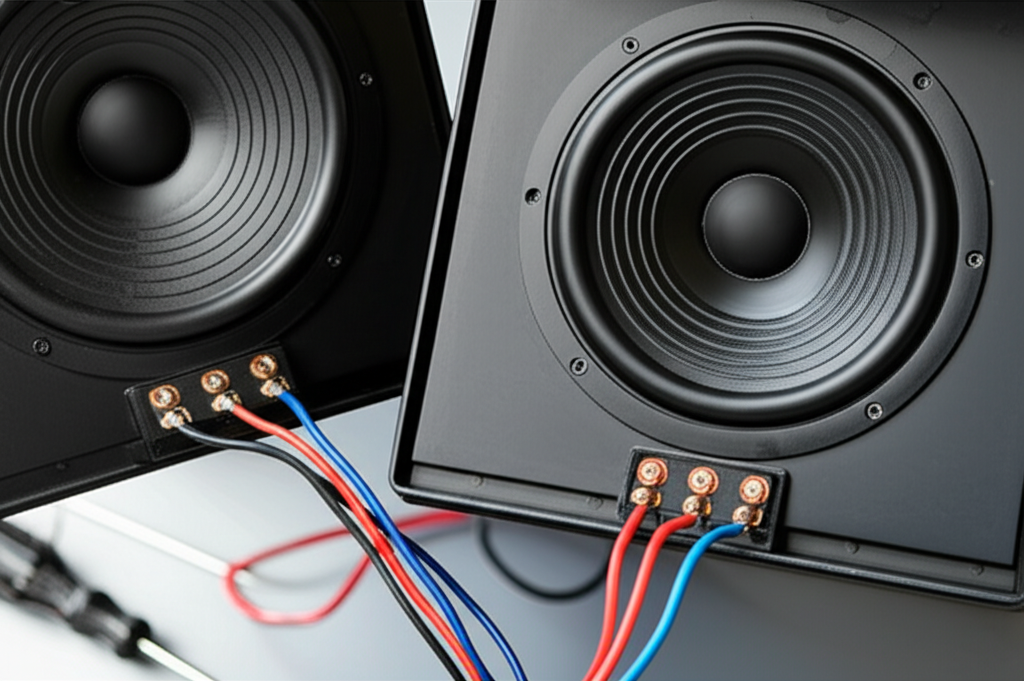
In a parallel connection, all the positive terminals of the speakers are connected together, and all the negative terminals are connected together. Then, the amplifier’s positive wire connects to this common positive bus, and the amplifier’s negative wire connects to the common negative bus.
- How it affects impedance: When you wire speakers in parallel, the total impedance decreases.
- Formula: 1 / Ztotal = 1 / Z1 + 1 / Z2 + … + 1 / Zn
- Example: Two 8-ohm speakers wired in parallel will present a total impedance of approximately 4Ω to the amplifier. (1/Ztotal = 1/8 + 1/8 = 2/8 = 1/4, so Ztotal = 4Ω).
- When to use it: Parallel wiring is used to decrease the total impedance, which is exactly what we need to aim for when trying to achieve a 2-ohm load from 8-ohm speakers.
Achieving a 2 Ohm Load with 8 Ohm Speakers
The goal is to take 8-ohm speakers and have them present a total impedance of 2 ohms to your amplifier. From what we’ve just learned, parallel wiring reduces impedance. Let’s see how many 8-ohm speakers we need in parallel to get close to 2 ohms.
Scenario 1: Using Two 8 Ohm Speakers
As calculated above, two 8-ohm speakers wired in parallel give us a total impedance of 4 ohms.
Formula: 1 / Ztotal = 1/8Ω + 1/8Ω = 2/8Ω = 1/4Ω
Ztotal = 4Ω
This is not 2 ohms. So, using just two 8-ohm speakers in parallel won’t get us to our target.
Scenario 2: Using Four 8 Ohm Speakers
Let’s try wiring four 8-ohm speakers in parallel.
Formula: 1 / Ztotal = 1/8Ω + 1/8Ω + 1/8Ω + 1/8Ω = 4/8Ω = 1/2Ω
Ztotal = 2Ω
Success! By wiring four 8-ohm speakers in parallel, you can achieve a total impedance of 2 ohms. This is the most common and straightforward method for 8 ohm to 2 ohm speaker wiring when you need to reach that specific impedance target.
Table: Speaker Wiring Configurations and Resulting Impedance
Here’s a quick summary to visualize how different configurations of 8-ohm speakers affect the total impedance:
| Number of 8Ω Speakers | Wiring Method | Total Impedance (Approximate) | Suitability for 2Ω Amplifier |
|---|---|---|---|
| 1 | N/A | 8Ω | No |
| 2 | Series | 16Ω | No |
| 2 | Parallel | 4Ω | No (too high) |
| 3 | Parallel | 2.67Ω (8Ω / 3) | Close, but not ideal |
| 4 | Series | 32Ω | No |
| 4 | Parallel | 2Ω | Yes! Ideal for 2Ω amplifier |
How to Wire Four 8 Ohm Speakers in Parallel (Step-by-Step Guide)
Now that we know we need four 8-ohm speakers wired in parallel, let’s get to the actual wiring. This assumes you have a basic understanding of electrical connections and how to use tools like wire strippers and screwdrivers. Always ensure your amplifier is turned off and unplugged before you begin any wiring.
What You’ll Need:
- Four 8-ohm speakers
- Speaker wire (appropriate gauge for your system)
- Wire strippers
- Wire crimpers or soldering iron and solder (optional, for more secure connections)
- Screwdrivers
- Wire nuts or terminal blocks (depending on your speaker and amplifier connection types)
- Your amplifier (rated for 2 ohms)
Steps:
- Prepare Your Workspace: Ensure your amplifier is powered off and unplugged. Work in a well-lit area where you have enough space.
- Identify Speaker Terminals: Each speaker will have a positive (+) and a negative (-) terminal. These are usually marked.
- Cut Speaker Wire: Measure and cut four short pieces of speaker wire for connecting the speakers to each other, and one longer piece to run from your speakers to the amplifier.
- Connect Speakers in Parallel (The Core of 8 Ohm To 2 Ohm Speaker Wiring):
- Take your first two speakers. Connect the positive (+) terminal of the first speaker to the positive (+) terminal of the second speaker using a short piece of speaker wire.
- Do the same for the negative (-) terminals: connect the negative (-) terminal of the first speaker to the negative (-) terminal of the second speaker.
- Now, take your third speaker. Connect its positive (+) terminal to the positive (+) terminals you just joined from the first two speakers.
- Connect its negative (-) terminal to the negative (-) terminals you just joined from the first two speakers.
- Finally, take your fourth speaker. Connect its positive (+) terminal to the common positive (+) connections already made.
- Connect its negative (-) terminal to the common negative (-) connections already made.
Think of this as creating four “junctions” where all the positives meet and all the negatives meet.
- Connect to the Amplifier:
- You should now have one main positive wire and one main negative wire running from your parallel speaker network.
- Connect the main positive wire to the positive (+) speaker output terminal on your amplifier.
- Connect the main negative wire to the negative (-) speaker output terminal on your amplifier.
- Double-Check Connections: Before powering anything on, meticulously check all your connections. Ensure no bare wires are touching each other or other components (this is critical to prevent shorts). Verify that positive wires go to positive terminals and negative wires go to negative terminals. A misplaced wire can cause serious damage.
- Power On and Test: Once you’re confident all connections are correct, turn on your amplifier and test your sound system at a low volume first. Gradually increase the volume to ensure everything sounds as expected.
Pro Tip: For the most secure and reliable connections, consider using crimp connectors or soldering the speaker wire to the terminals. This prevents wires from coming loose over time due to vibrations, especially crucial in car audio installations.
Important Considerations for 8 Ohm To 2 Ohm Speaker Wiring
While wiring four 8-ohm speakers in parallel is the standard way to achieve a 2-ohm load, there are a few other critical factors to keep in mind to ensure your system performs optimally and safely.
Amplifier Compatibility
This is paramount. Your amplifier must be rated to handle a 2-ohm load. Many amplifiers have different power ratings for 8-ohm, 4-ohm, and 2-ohm loads. Running a 2-ohm load on an amplifier that is only stable at 4 ohms or 8 ohms will likely cause it to overheat and shut down, or worse, suffer permanent damage. Always consult your amplifier’s manual to confirm its impedance stability and power output at 2 ohms. According to Crutchfield’s guide on amplifier power ratings, understanding these specifications is key to preventing damage.
Speaker Quality and Power Handling
When you wire speakers in parallel, the amplifier’s total power is divided among them. So, if your amplifier outputs 100 watts at 2 ohms, each of your four 8-ohm speakers will receive approximately 25 watts of power. Ensure that each of your 8-ohm speakers has a power handling capacity (RMS rating) that is suitable for the power they will actually receive. Running speakers beyond their power handling capacity can lead to distortion and speaker damage.
Wire Gauge
Using the correct gauge (thickness) of speaker wire is important, especially for longer runs or higher power systems. Thicker wires (lower gauge number) have less resistance and can carry current more efficiently. For most 2-ohm systems, 16-gauge wire is a good starting point, but 14-gauge or even 12-gauge might be better for longer runs or very high-power amplifiers. The National Electrical Code (NEC) provides guidelines for safe electrical installations, and while speaker wire has different considerations, understanding basic electrical principles is beneficial.
Series-Parallel Combinations (Advanced)
While not directly for 8 ohm to 2 ohm wiring with 8-ohm speakers, it’s worth noting that more complex configurations exist. For example, you could wire two 4-ohm speakers in series (total 8 ohms) and then wire that pair in parallel with another pair of two 4-ohm speakers in series (total 8 ohms). This would result in a total of 4 ohms (8Ω || 8Ω = 4Ω). This demonstrates how series and parallel can be combined, but for your specific goal of 8 ohm to 2 ohm speaker wiring using 8-ohm speakers, four in parallel is the simplest and most direct method.
Troubleshooting Common Issues
Even with the best intentions, sometimes things don’t work perfectly the first time. Here are a few common issues you might encounter during 8 ohm to 2 ohm speaker wiring and how to fix them:
No Sound
- Check Amplifier Power: Is the amplifier on? Is it in protection mode? Many amps have indicator lights to show if they’ve detected a fault.
- Verify Connections: Go back and re-check every single wire. A loose connection or a wire in the wrong terminal is the most common culprit. Ensure wires are stripped adequately and making good contact.
- Speaker Wiring Order: Although phase is crucial for sound quality, incorrect phasing (positive to negative, negative to positive on one speaker) usually just results in weak bass or cancellation, not complete silence from all speakers. However, a complete short circuit would definitely kill the sound and potentially the amp.
- Speaker Functionality: Test each speaker individually with a known working amplifier or a battery test (briefly touch speaker terminals with a 1.5V AA battery – the cone should move briefly).
Distorted Sound or Crackling
- Overdriving the Amplifier: You might be turning the volume up too high for the amplifier or speakers. Try turning the volume down.
- Poor Connections: Loose wires can cause intermittent contact, leading to crackling.
- Speaker Power Handling: The speakers might be receiving more power than they can handle, causing distortion. Ensure your speakers’ RMS power rating is appropriate for the power they’re receiving at 2 ohms.
- Bad Speaker Component: One or more of the speakers might be damaged.
Amplifier Overheating or Shutting Down
- Impedance Mismatch: This is the most serious. Double-check that your amplifier is indeed stable at 2 ohms and that your wiring has correctly resulted in a 2-ohm load. If the actual impedance is lower than 2 ohms (e.g., due to faulty speakers or poor wiring), the amplifier will be severely stressed. A study by the Audio Engineering Society (AES) often discusses amplifier design and load stability, highlighting the importance of matching.
- Short Circuit: Ensure no bare wires are touching each other or the vehicle chassis (if applicable), which can create a short.
- Insufficient Ventilation: Make sure the amplifier has plenty of space around it for airflow.
Frequently Asked Questions (FAQ)
Q1: Can I wire two 8-ohm speakers in parallel to get 4 ohms, and then use that with a 2-ohm amplifier?
A1: While wiring two 8-ohm speakers in parallel results in a 4-ohm load, this is generally not what you want for a 2-ohm amplifier. Most amplifiers designed for 2-ohm operation deliver significantly more power at that impedance. Using a 4-ohm load will result in less power output than the amplifier is capable of at 2 ohms, and you won’t achieve the intended performance. You’d need four 8-ohm speakers wired in parallel to achieve a 2-ohm load.
Q2: What happens if I wire 8-ohm speakers in series to try and get a 2-ohm system?
A2: Wiring speakers in series adds their impedances together. For example, two 8-ohm speakers in series would present a 16-ohm load to the amplifier. This is far too high for an amplifier designed for 2 ohms and would result in very low volume and poor performance, not the intended outcome.
Q3: Can I use a mix of 8-ohm and 4-ohm speakers to get a 2-ohm load?
A3: It’s possible but very complex and generally not recommended for beginners. You would need to carefully calculate the combined impedance using series and parallel configurations. For example, two 4-ohm speakers in parallel make 2 ohms. Then, perhaps four 8-ohm speakers in parallel also make 2 ohms. If you try to mix them in a single parallel circuit, the math gets complicated and the impedance might not be stable. It’s usually best to stick to using identical speakers when aiming for a specific target impedance like 2 ohms.
Q4: Will my amplifier provide more power with 8-ohm speakers wired to create a 2-ohm load?
A4: Yes, a 2-ohm load allows your amplifier to deliver more power than it would at 4 or 8 ohms (assuming it’s designed for it). This is why people aim for lower impedances in car audio – to get more volume and impact from their amplifier. However, remember this increased power can also stress the amplifier and speakers more if not properly managed.
Q5: How can I be sure my speaker wiring is correct for 8 ohm to 2 ohm conversion?
A5: The most reliable way is to use a multimeter. Set it to measure resistance (ohms). Disconnect the speakers from the amplifier, and then measure the resistance across the main positive and negative wires that would connect to the amplifier. It should read very close to 2 ohms (typically between 1.8 and 2.2 ohms is acceptable). The National Institute of Standards and Technology (NIST) provides foundational principles for accurate measurement.
Q6: What if I only have three 8-ohm speakers?
A6: With three 8-ohm speakers wired in parallel, the total impedance would be 8Ω / 3 ≈ 2.67 ohms. This is closer to 2 ohms than 4 ohms, but it’s still higher. Some amplifiers might tolerate this, but it’s not ideal. It’s best to use four speakers for a precise 2-ohm load, or if you absolutely must use three, ensure your amplifier is stable at loads slightly above 2 ohms and monitor it closely for heat.
Conclusion
Successfully navigating the world of 8 ohm to 2 ohm speaker wiring is entirely achievable, even for beginners. By understanding the fundamentals of speaker impedance and the impact of series versus parallel connections, you can confidently configure your speakers to meet your amplifier’s requirements. Remember, the key to reaching a 2-ohm impedance using 8-ohm speakers is to wire exactly four of them in parallel. Always prioritize safety by ensuring your amplifier is compatible with a 2-ohm load and by double-checking all your connections before powering up your system. With a little care and attention to detail, you’ll be enjoying enhanced audio performance in no time!
