

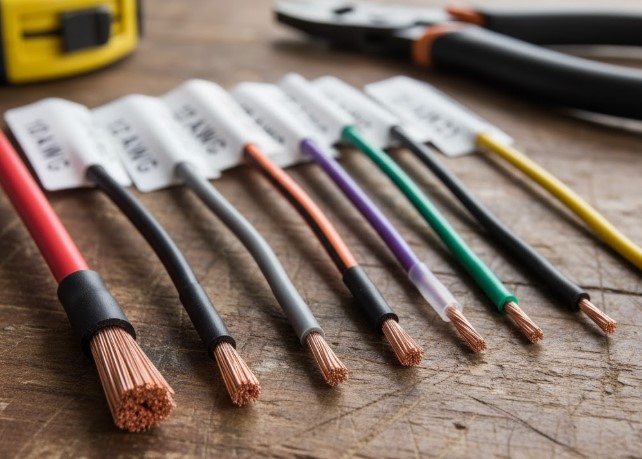
Choose the right speaker wire gauge for optimal sound quality and system performance. The best choice depends on speaker impedance and wire length, typically ranging from 16-gauge for short runs to 12-gauge for longer distances and lower impedances.
Key Takeaways
- Match speaker wire gauge to impedance and length.
- Thicker wires (lower gauge number) are better for longer runs.
- Use 16-gauge for short distances and higher impedance speakers.
- Employ 12-gauge or 14-gauge for demanding setups and cleaner sound.
- Avoid undersized wires to prevent signal loss and overheating.
Are you setting up a new home theater, upgrading your audio system, or simply trying to understand what that “gauge” number on speaker wire actually means? It’s a common point of confusion for many audio enthusiasts, especially when you want to ensure your speakers sound their absolute best. Picking the wrong speaker wire gauge can lead to disappointing sound quality, reduced volume, and even damage to your equipment. This guide will break down everything you need to know about recommended speaker wire gauge, making it easy for you to choose the best option for your setup with confidence.
Understanding Speaker Wire Gauge Basics
Before we dive into recommendations, let’s quickly cover what “speaker wire gauge” means. Wire gauge is a measurement of the wire’s thickness. The lower the gauge number, the thicker the wire. Think of it like road lanes: a 12-lane highway (12-gauge wire) can handle much more traffic (electrical current) than a 2-lane road (2-gauge wire).
Why does wire thickness matter for your speakers? It all comes down to electrical resistance. Thicker wires have lower resistance, which means less of the precious audio signal gets lost or weakened as it travels from your amplifier to your speakers. This loss is known as signal degradation or attenuation. A thicker wire minimizes this loss, ensuring that the sound reaching your speakers is as close as possible to what the amplifier intended.
The Society of Plastics Engineers (SPE) provides standards for wire dimensions, which helps manufacturers produce consistent wire gauges. However, you don’t need to be an expert in SPE standards; understanding the basic principle of lower gauge = thicker wire = less resistance is the key.
The Impact of Wire Gauge on Sound Quality
Imagine trying to push water through a very narrow straw versus a wide pipe. The water flows much more easily and with greater force through the wider pipe. Speaker wire works similarly. Audio signals are essentially electrical currents, and they need a clear path to travel without obstruction. When the wire is too thin (high gauge number) for the distance or the speaker’s demands, the audio signal encounters more resistance. This resistance can lead to:
- Reduced Bass Response: Low frequencies require more power to reproduce. Thin wires struggle to carry these bass signals effectively, resulting in weak or muddy bass.
- Lower Volume Levels: More signal is lost before it reaches the speaker, meaning you might have to turn up your amplifier volume higher to achieve the same loudness.
- Loss of Detail and Dynamics: Subtle nuances in music or sound effects can be smoothed over or lost entirely due to signal degradation.
- Potential for Overheating: In extreme cases, a wire that is too thin for the current it’s carrying can overheat, posing a fire hazard and damaging your amplifier or speaker.
Choosing the correct speaker wire gauge is crucial for unlocking your audio system’s full potential, ensuring crisp highs, clear mids, and impactful bass.
Factors Determining the Best Speaker Wire Gauge
There isn’t a single “best” speaker wire gauge for everyone. The ideal choice for your setup depends primarily on two crucial factors:
- Speaker Impedance (Ohms): This measures how much resistance your speakers offer to the electrical current from the amplifier. It’s usually listed in ohms (Ω) on the back of your speakers or in their manual. Common impedances are 8Ω, but some systems might use 4Ω or even 6Ω speakers. Lower impedance speakers require thicker wires (lower gauge numbers) to handle the increased current.
- Wire Length: The longer the distance the audio signal has to travel, the more resistance the wire will naturally have. Therefore, longer wire runs require thicker wires to compensate for the increased length.
A good rule of thumb is that for every significant increase in wire length, you might need to step down in gauge number (get a thicker wire). Similarly, if you’re running speakers at a lower impedance, you’ll need a thicker wire than you would for higher impedance speakers at the same distance.
Recommended Speaker Wire Gauge Chart
To help you make an informed decision, here’s a general chart based on common speaker impedances and wire lengths. This chart is designed to maintain signal integrity without introducing noticeable loss. Remember, these are guidelines, and erring on the side of a thicker wire (lower gauge number) is usually a safe bet for better performance.
| Wire Length (Feet) | 8 Ohm Speakers | 6 Ohm Speakers | 4 Ohm Speakers |
|---|---|---|---|
| 0-25 | 18 AWG | 16 AWG | 16 AWG |
| 25-50 | 16 AWG | 14 AWG | 12 AWG |
| 50-75 | 14 AWG | 12 AWG | 10 AWG |
| 75-100 | 12 AWG | 10 AWG | 10 AWG |
| 100-150 | 10 AWG | 10 AWG | 8 AWG |
Note: AWG stands for American Wire Gauge. Lower numbers indicate thicker wires.
This chart is a solid starting point. For example, if you have 8-ohm bookshelf speakers and your amplifier is only 15 feet away, 18 AWG wire might suffice. However, if those same 8-ohm speakers are 70 feet away, you’d want to upgrade to 14 AWG wire. For a powerful home theater system with demanding 4-ohm floor-standing speakers, you might need 12 AWG even for moderate distances.
Understanding the Wire Gauge Numbers (AWG)
As mentioned, AWG is the standard for measuring wire thickness. The higher the number, the thinner the wire. Here’s a quick breakdown of common gauges and what they typically mean:
- Higher Gauge Numbers (e.g., 20 AWG, 22 AWG): These are thinner wires. They are suitable for very short runs (under 20 feet) and very high impedance speakers (e.g., some small satellite speakers or older hi-fi systems). They are also less expensive.
- Mid-Range Gauge Numbers (e.g., 16 AWG, 18 AWG): These are good all-around choices for many common setups. 16 AWG is a very popular choice for most home audio systems with speakers up to 50 feet away and 8-ohm impedance.
- Lower Gauge Numbers (e.g., 12 AWG, 14 AWG): These are thicker wires. They are essential for longer runs (over 50 feet), lower impedance speakers (4-ohm or 6-ohm), or high-power systems where a lot of current is being pushed. They offer the least resistance and best signal transfer.
- Very Low Gauge Numbers (e.g., 10 AWG, 8 AWG): These are very thick, heavy-duty wires. They are typically used for installations requiring very long runs or for subwoofers and high-end audio systems that demand maximum power delivery.
The Federal Trade Commission (FTC) has regulations regarding the advertising of wire and cable, ensuring that gauge numbers are accurate and not misleading. However, it’s always wise to purchase from reputable brands to ensure you’re getting what you pay for. Organizations like the Consumer Product Safety Commission (CPSC) also offer general advice on electrical safety, including considerations for wiring.
Common Speaker Wire Types
Beyond gauge, you’ll encounter different types of speaker wire. The most common for home audio are:
- CL2/CL3 Rated Wire: These wires are designed for in-wall installation and meet safety codes for transmitting audio signals through walls and plenums. They have a jacket that’s designed to reduce fire risk.
- Plenum-Rated Wire: Specifically designed for use in air handling spaces (plenums) in commercial buildings, these wires have a special jacket that emits less smoke and toxic gases when burned.
- Outdoor/UV-Resistant Wire: For setups that will be exposed to the elements, look for wire jacketed to withstand UV rays and moisture.
- Standard Zip Cord: This is the most common type for exposed runs or installations where in-wall rating isn’t required. It’s typically a two-conductor wire with a simple plastic jacket.
For most home users, standard zip cord or CL2/CL3 rated wire (if you plan on running it through walls) will be your best bet. The gauge is still the primary factor for sound quality, but the jacket type is important for safety and installation location.
When to Choose Thicker Wire (Lower Gauge Number)
You should lean towards a thicker speaker wire (lower gauge number) in the following scenarios:
- Long Wire Runs: If you need to connect your amplifier to speakers located more than 50 feet away, using 14 AWG or 12 AWG is highly recommended to minimize signal loss.
- Low Impedance Speakers (4Ω or 6Ω): Speakers with lower impedance draw more current from the amplifier. Thicker wires (14 AWG or 12 AWG) are necessary to handle this current without significant resistance.
- High-Power Systems: If you have a powerful amplifier demanding a lot of current, or if you frequently listen at very high volumes, thicker wire ensures the signal remains robust.
- Subwoofers: Subwoofers often require more power and can benefit from thicker gauge wire to ensure strong bass reproduction.
- Delicate Audio Signals: For audiophile setups where every detail matters, investing in thicker wire (like 12 AWG or even 10 AWG) for all your speakers can provide a perceivable improvement in clarity and dynamics.
Pro Tip: Future-Proof Your Setup
Even if your current system doesn’t demand the thickest wire, consider using 12 AWG or 14 AWG for all your speaker runs. It’s relatively inexpensive to upgrade from 18 AWG to 14 AWG or 12 AWG, and it future-proofs your installation. If you ever upgrade to more demanding speakers or move things around, you won’t have to re-run wires.
When Can You Get Away with Thinner Wire (Higher Gauge Number)?
While thicker is often better, there are situations where thinner wire is perfectly acceptable:
- Short Distances: For systems where speakers are located less than 20-25 feet from the amplifier, even 18 AWG wire can perform adequately, especially with 8-ohm speakers.
- High Impedance Speakers (8Ω or higher): Standard 8-ohm speakers don’t draw as much current as lower impedance models, so thinner wires are less likely to cause significant issues on shorter runs.
- Budget Constraints: If you’re on a tight budget and setting up a basic audio system, 16 AWG or 18 AWG wire can be a cost-effective solution for shorter runs.
- Background Music Systems: For systems intended for casual listening or background music where ultimate fidelity isn’t the primary concern, thinner wires might be sufficient.
It’s important to note that “getting away with” thinner wire means you might be sacrificing some sound quality, especially in the bass frequencies. However, for many everyday users, the difference might not be dramatically noticeable on short runs with standard speakers.
Comparing Wire Gauges: A Quick Look
Let’s visualize the difference in thickness and resistance for common speaker wire gauges. This table shows how much resistance is introduced per 100 feet of wire for copper conductors. According to the Copper Development Association, the resistance of copper wire varies with temperature and purity, but these are typical values.
| Gauge (AWG) | Diameter (mm) | Resistance (Ohms per 100ft) |
|---|---|---|
| 10 | 2.586 | 0.0999 |
| 12 | 2.053 | 0.159 |
| 14 | 1.628 | 0.252 |
| 16 | 1.291 | 0.400 |
| 18 | 1.024 | 0.637 |
| 20 | 0.812 | 1.013 |
As you can see, the resistance drops significantly as the gauge number decreases (wire gets thicker). For instance, 12 AWG wire has less than half the resistance of 16 AWG wire per 100 feet. This lower resistance is what translates to better signal delivery.
How to Measure for Speaker Wire
Accurate measurement is key to buying the right amount of wire. Here’s how to do it:
- Identify Speaker Locations: Determine where your speakers will be placed relative to your amplifier or receiver.
- Measure from Amplifier to Speaker: Use a tape measure to find the distance from the amplifier’s speaker terminal to each speaker’s terminal.
- Add Extra Length: Always add a few extra feet (5-10 feet per run) to account for slack, routing around furniture, and potential future adjustments. It’s much better to have a little extra than to be just a foot short.
- Account for Both Channels: Remember that a stereo system requires two separate speaker runs (left and right). For surround sound, you’ll have even more runs.
- Consider Wire Type: If you’re installing in-wall, ensure you purchase the correct CL2/CL3 rated wire for safety and code compliance.
Frequently Asked Questions (FAQ)
What is the most common recommended speaker wire gauge for home audio?
For most home audio systems with 8-ohm speakers and runs under 50 feet, 16 AWG is a very common and effective choice. It offers a good balance of performance and cost.
Does speaker wire gauge affect bass?
Yes, absolutely. Thicker wires (lower gauge numbers) have less resistance, allowing more power, especially for low frequencies, to reach the speakers, resulting in tighter, more impactful bass.
Can I use different gauge wires for different speakers in my system?
While you can, it’s generally recommended to use the same gauge wire for all speakers in a stereo pair or within a zone to ensure consistent performance. For a full surround sound system, using the same gauge throughout is ideal for a cohesive audio experience.
Is it okay to use two thinner wires (like 18 AWG) twisted together to act as one thicker wire?
No, this is generally not recommended. Standard speaker wire is designed in a specific way, and twisting multiple thinner wires together doesn’t replicate the performance of a single, properly gauged wire and can lead to uneven current distribution and potential issues.
What happens if I use wire that is too thin?
Using wire that is too thin for the length of the run or the speaker’s impedance can lead to signal loss, reduced volume, poor bass response, and in extreme cases, the wire may overheat, posing a fire risk and potentially damaging your equipment.
Should I use solid core or stranded speaker wire?
For speaker wires, stranded wire is generally preferred. It’s more flexible, making it easier to run and connect, and it’s less prone to breaking if it’s moved frequently. Solid core wire is usually better suited for permanent in-wall installations where it won’t be disturbed.
Does the material of the speaker wire (copper vs. aluminum) matter?
Yes. Oxygen-Free Copper (OFC) is the standard for good quality speaker wire due to its excellent conductivity. CCA (Copper Clad Aluminum) is less conductive and has higher resistance, making it less ideal. For best performance, always choose 100% copper wire.
Conclusion
Selecting the best speaker wire gauge is a straightforward process once you understand the core principles. By considering your speaker’s impedance and the total length of your wire runs, you can confidently choose a gauge that ensures your audio system performs at its peak. Remember, the goal is to minimize resistance and signal loss, delivering clean, powerful sound to your speakers.
For most everyday users with 8-ohm speakers and runs under 50 feet, 16 AWG is a solid, reliable choice. If you have lower impedance speakers (4 or 6 ohms), longer runs (over 50 feet), or a high-performance system, stepping up to 14 AWG or 12 AWG is a worthwhile investment that will pay dividends in superior sound quality. Don’t let confusing jargon hold you back from enjoying your music and movies to their fullest. With the right speaker wire gauge, you’re one step closer to an immersive audio experience.
