

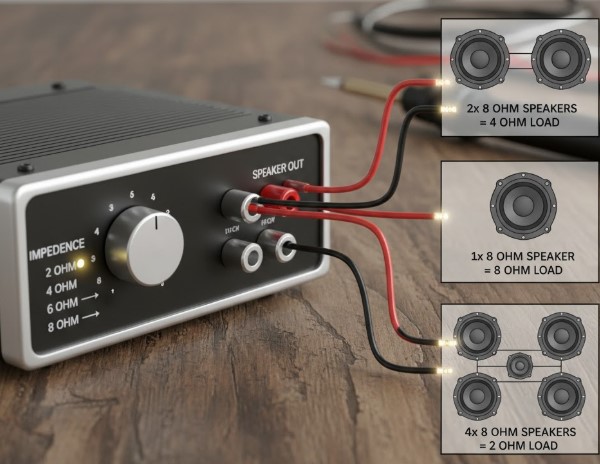
If you’ve ever tried connecting 8-ohm speakers with a 6-ohm, 4-ohm, or 2-ohm amplifier, you know it can get confusing fast. It’s one of those tricky parts of home audio setup that looks simple until your amp overheats or your sound suddenly distorts. You might wonder, “Why does this even matter? Can’t I just plug them in and play?” Well, technically, you can—but without proper wiring and impedance matching, your gear could suffer.
In this guide, we’ll break down everything you need to know about wiring 8 ohm speakers with 6 ohm, 4 ohm, or 2 ohm amplifier setups. We’ll explore how impedance affects power delivery, what wiring methods actually work, and how to achieve the cleanest, safest sound possible—without frying your amp or muffling your music.
Let’s dive in.
Understanding Impedance: The Backbone of Audio Wiring
Before we get to the practical wiring steps, it’s important to understand what impedance really means. Impedance, measured in ohms (Ω), represents how much resistance your speaker offers to the electrical current coming from your amplifier. You can think of it like water flowing through a hose—the smaller the hose (lower impedance), the easier electricity flows, and the more power the speaker draws.
However, if your amplifier isn’t designed to handle low impedance, it might overheat or shut down. On the other hand, if the impedance is too high, your speakers won’t draw enough power, resulting in weak or distorted sound.
Here’s a quick overview:
| Impedance (Ohms) | Power Draw | Typical Effect |
|---|---|---|
| 2 Ohms | High | Very loud, risky for amps |
| 4 Ohms | Moderate | Good balance, standard for car amps |
| 6 Ohms | Slightly lower | Common for home theater systems |
| 8 Ohms | Safe, lower draw | Cleaner sound, but less loud |
When mixing different impedances—like connecting 8-ohm speakers to a 4-ohm amplifier—your goal is to balance power and protection.
Why Matching Impedance Matters More Than You Think
Think of your amp and speakers like dance partners—they need to move in sync. When the amplifier’s rated impedance doesn’t match your speakers’, one partner ends up doing all the heavy lifting. The result? Either overheating or underperformance.
If the speaker impedance is too low, your amp has to deliver more current than it was designed for. This can lead to clipping, distortion, or even permanent damage.
If the speaker impedance is too high, your amp won’t push enough current, and your sound will feel thin and underpowered.
So, when dealing with wiring 8 ohm speakers with 6 ohm, 4 ohm, or 2 ohm amplifier, the trick is to adjust wiring configurations—series or parallel—to create a balanced load that keeps both components happy.
Series vs Parallel Wiring: What’s the Difference?

When wiring multiple speakers, the total impedance depends on how they’re connected. Understanding series and parallel wiring will help you calculate the right load for your amplifier.
Series Wiring:
- You connect speakers end-to-end: positive to negative, and so on.
- The total impedance adds up.
- Formula:
Total Impedance = Speaker 1 + Speaker 2 + …
Parallel Wiring:
- You connect all positives together and all negatives together.
- The total impedance decreases.
- Formula:
1 / Total Impedance = 1 / Speaker 1 + 1 / Speaker 2 + …
Example:
Two 8-ohm speakers:
- In series = 16 ohms (8 + 8)
- In parallel = 4 ohms (1 / (1/8 + 1/8))
So, by changing wiring type, you can fine-tune your setup to match your amplifier’s impedance.
Wiring 8-Ohm Speakers to a 6-Ohm Amplifier
Let’s start with the most common mismatch—8-ohm speakers on a 6-ohm amplifier. This pairing is relatively safe, but you still need to be cautious.
If you’re using a single 8-ohm speaker, you can connect it directly to your amplifier. The impedance difference isn’t dramatic. Your amp will push slightly less power, and your speaker will produce a bit less volume, but the sound quality will remain clean. Just avoid running the system at full blast for long periods.
However, if you have multiple speakers, wiring plays a huge role.
Here’s how you can handle different setups:
| Number of 8-Ohm Speakers | Wiring Type | Total Impedance | Safe for 6-Ohm Amp? |
|---|---|---|---|
| 1 | Direct | 8Ω | Yes, safe |
| 2 | Parallel | 4Ω | No, risky |
| 3 | Series/Parallel mix | ~5.3Ω | Yes, safe |
| 4 | Series-Parallel | 8Ω | Yes, safe |
For example, four 8-ohm speakers in a series-parallel configuration can give you a combined load close to 8 ohms, which is compatible with a 6-ohm amp.
Just remember: your amp’s impedance rating is the minimum it can safely handle. Anything higher (like 8 ohms on a 6-ohm amp) is generally fine, but going lower (like 4 ohms on a 6-ohm amp) can overload it.
Quick tip:
Always start your volume low when testing a new configuration. Feel your amp’s surface after 10–15 minutes. If it’s getting too hot, reduce the volume or recheck your wiring.
Wiring 8-Ohm Speakers to a 4-Ohm Amplifier
This setup is where most people get nervous. A 4-ohm amplifier is built to deliver higher current, and connecting 8-ohm speakers means the system won’t reach its full volume potential. It’s not dangerous, but you’ll lose efficiency.
If you have only one 8-ohm speaker, connect it directly to the amplifier. Your amp will simply deliver less power, and the volume will be noticeably lower compared to a 4-ohm speaker.
However, if you have two 8-ohm speakers, there’s an easy fix:
Connect them in parallel, and the total impedance will drop to 4 ohms, perfectly matching your amp. This way, your amplifier runs efficiently, and you get clear, balanced sound.
For 3 or 4 speakers, it gets trickier:
| Number of 8-Ohm Speakers | Wiring Type | Total Impedance | Safe for 4-Ohm Amp? |
|---|---|---|---|
| 1 | Direct | 8Ω | Safe but less loud |
| 2 | Parallel | 4Ω | Perfect match |
| 3 | Parallel | 2.67Ω | Risky unless amp supports 2.7Ω |
| 4 | Series-Parallel | 8Ω | Safe, but not ideal for power output |
With four speakers, a series-parallel layout gives you an 8-ohm total, which is safe but not optimal for a 4-ohm amp—it won’t fully utilize its power.
So, the best approach for wiring 8 ohm speakers with 4 ohm amplifier is to use two speakers in parallel. It’s efficient, balanced, and completely safe for both components.
Pro Tip:
If you notice that your amp is getting hot or the sound distorts at high volume, double-check the total impedance. Even small miscalculations can affect performance.
Wiring 8-Ohm Speakers to a 2-Ohm Amplifier
Now, this is where things get intense. A 2-ohm amplifier is designed to deliver a huge amount of current. Connecting a single 8-ohm speaker to it isn’t harmful, but it will drastically reduce output volume because the amp can’t push full power through such a high impedance.
The danger comes when the opposite happens—connecting too low of an impedance. That can fry your amp’s output stage.
So, how do you make 8-ohm speakers work with a 2-ohm amp safely? Through smart wiring combinations.
| Number of 8-Ohm Speakers | Wiring Type | Total Impedance | Safe for 2-Ohm Amp? |
|---|---|---|---|
| 1 | Direct | 8Ω | Safe but low power |
| 2 | Parallel | 4Ω | Safe if volume controlled |
| 3 | Parallel | 2.67Ω | Good match |
| 4 | Parallel | 2Ω | Perfect match |
If you have four 8-ohm speakers, wiring them all in parallel gives you exactly 2 ohms. This perfectly matches your amp and allows full power output without risk.
However, it’s critical to ensure your amp can handle sustained power draw at 2 ohms. Not all amplifiers that claim 2-ohm stability can maintain it for long periods. Monitor heat and sound clarity during use.
How to Calculate Total Impedance (Step-by-Step Guide)
When wiring multiple speakers, it’s essential to know how to calculate the total impedance so your amplifier doesn’t suffer. Don’t worry—it sounds more technical than it really is. You can think of it like math for music. Once you get the formula, it becomes second nature.
Let’s go step by step.
For Series Wiring:
If your speakers are connected end to end, simply add the ohm ratings together.
Example:
Two 8-ohm speakers in series:
8Ω + 8Ω = 16Ω total
That’s it. The total impedance increases as you add more speakers in series.
For Parallel Wiring:
This one’s a bit different. The total impedance actually goes down as you add more speakers because the electrical current has multiple paths to travel.
Use this formula:
1 / Total Impedance = 1 / Speaker1 + 1 / Speaker2 + …
Example:
Two 8-ohm speakers in parallel:
1 / Total = 1/8 + 1/8 → 1 / Total = 1/4 → Total = 4 ohms
If you have three 8-ohm speakers in parallel:
1 / Total = 1/8 + 1/8 + 1/8 = 3/8 → Total = 2.67 ohms
This formula helps you decide how many speakers your amp can safely power. It’s the foundation for safely wiring 8 ohm speakers with 6 ohm, 4 ohm, or 2 ohm amplifier systems.
Using a Speaker Ohm Calculator
If doing math isn’t your thing, no worries. Many online tools can do this instantly for you. Just plug in the number of speakers, their impedance (for example, 8 ohms), and the wiring type (series or parallel). The calculator will show you the total impedance automatically.
Such calculators are especially helpful when you’re experimenting with different configurations. You can quickly find out whether your 6-ohm, 4-ohm, or 2-ohm amplifier can handle your setup before actually wiring it.
This simple step can save your expensive amplifier from potential damage and help you achieve a balanced sound output.
Real-World Examples: Finding the Perfect Balance
Let’s make it more practical with real-world examples that reflect how impedance matching affects performance.
Example 1: Two 8-Ohm Speakers with a 4-Ohm Amplifier
You wire them in parallel, and the total impedance becomes 4 ohms.
That’s a perfect match. The amplifier delivers maximum power efficiently, and the speakers sound crisp and loud without distortion.
Example 2: One 8-Ohm Speaker with a 2-Ohm Amplifier
Here, the speaker impedance is higher than the amplifier’s rating. The result? You’ll get less power output and a noticeable drop in volume. It’s safe, but not ideal for powerful setups.
Example 3: Four 8-Ohm Speakers with a 6-Ohm Amplifier
If you wire all four in a series-parallel configuration, you can achieve an 8-ohm total load—close enough to 6 ohms. This balance ensures safety and stable sound, even during long listening sessions.
Example 4: Three 8-Ohm Speakers on a 2-Ohm Amplifier
When wired in parallel, the total impedance is 2.67 ohms—very close to your amplifier’s rating. This combination delivers solid performance, but keep an eye on your amp’s temperature when playing at high volumes.
These examples show how flexible impedance matching can be once you understand wiring types and calculations.
Safety Precautions When Mixing Impedances
Matching impedance isn’t just about sound quality—it’s about protecting your equipment. Here are a few crucial safety tips to follow:
- Never go below the amplifier’s minimum impedance rating.
For instance, if your amp is rated at 4 ohms, don’t wire speakers in a way that results in 2 ohms. That’s a quick way to overheat or blow an output stage. - Keep the wiring connections secure.
Loose wires can create resistance spikes that damage your amp or cause audio cutouts. - Start with low volume when testing.
It’s safer to start quietly and gradually raise the volume while monitoring your amp’s behavior. - Monitor for distortion or heat.
Distortion is often the first sign that your impedance setup is off-balance. - Use thicker gauge speaker wire for longer runs.
This reduces resistance and improves clarity, especially for low-impedance systems.
By taking these precautions, you can experiment confidently with wiring 8 ohm speakers with 6 ohm, 4 ohm, or 2 ohm amplifier configurations.
Troubleshooting Common Problems
Even with the best setup, issues can still arise. Here are some common problems and how to fix them:
1. Amplifier Overheating
- Possible Cause: Total impedance too low or poor ventilation.
- Solution: Check your wiring configuration. Make sure your combined impedance isn’t below the amp’s rating. Also, keep your amp in a well-ventilated area.
2. Weak or Distorted Sound
- Possible Cause: Impedance too high, resulting in low power output.
- Solution: Use parallel wiring to reduce total impedance and let your amp deliver more current.
3. One Speaker Louder Than Another
- Possible Cause: Mismatched wiring or uneven load distribution.
- Solution: Double-check connections and make sure all speakers are wired identically.
4. Amp Protection Mode Activating
- Possible Cause: The amp senses a dangerous load.
- Solution: Disconnect everything, calculate the impedance again, and reconnect speakers using a safer configuration.
When in doubt, always choose a configuration with slightly higher impedance rather than lower. Your amp will thank you for it.
How to Optimize Sound Quality in Mismatched Systems
Even when impedances don’t perfectly match, you can still get great results. Here are some quick tweaks to get the best sound possible:
- Balance Your Channels: Use the amplifier’s gain controls to equalize volume between mismatched speakers.
- Position Speakers Properly: Distance and angle matter more than you think. A well-positioned 8-ohm speaker can outperform a poorly placed 4-ohm one.
- Use a Crossover Network: This helps distribute frequencies correctly, preventing overloads and improving clarity.
- Avoid Maximum Volume: Running your amp at full throttle, especially in mismatched setups, can shorten its lifespan.
- Experiment with Room Acoustics: Soft furnishings, wall angles, and even curtains can influence perceived loudness and tone.
By combining proper wiring with smart tuning, you can make almost any system sing beautifully.
Quick Comparison Table: Which Wiring Setup Works Best?
Here’s a simple table summarizing ideal configurations for different amplifiers when using 8-ohm speakers.
| Amplifier Rating | Best Wiring Method | Ideal Number of Speakers | Total Impedance | Performance |
|---|---|---|---|---|
| 6 Ohms | Series-Parallel | 4 Speakers | 8Ω | Balanced and safe |
| 4 Ohms | Parallel | 2 Speakers | 4Ω | Efficient and clean |
| 2 Ohms | Parallel | 4 Speakers | 2Ω | Maximum output, monitor heat |
| 2 Ohms | Parallel | 3 Speakers | 2.67Ω | Close match, safe volume |
| 4 Ohms | Direct | 1 Speaker | 8Ω | Safe, reduced power |
This table makes it easier to visualize which setup best matches your amplifier’s capacity and your number of speakers.
Key Takeaways for Safe and Powerful Audio Setup
- Always know your amplifier’s minimum impedance rating.
- Never go below it, even if your speakers are rated higher.
- Use parallel wiring to lower impedance and series wiring to raise it.
- When unsure, choose a configuration that results in slightly higher impedance.
- Keep your system cool and monitor distortion signs regularly.
- A good impedance match ensures longer amp life, cleaner sound, and safer performance.
FAQs: Wiring 8 Ohm Speakers With 6 Ohm, 4 Ohm, or 2 Ohm Amplifier
1. Can I connect 8-ohm speakers to a 4-ohm amplifier directly?
Yes, you can. It’s safe but not optimal. Your amplifier will deliver less power, so the volume will be lower. If you want full performance, add another 8-ohm speaker in parallel to achieve a total of 4 ohms.
2. What happens if my amplifier’s impedance is lower than my speakers’?
The sound will be quieter, but you won’t damage your gear. The danger arises when the amplifier’s impedance rating is higher and your speakers pull more current than it can handle.
3. How can I make 8-ohm speakers match a 2-ohm amplifier?
You can wire four 8-ohm speakers in parallel. The total impedance will be exactly 2 ohms, perfectly matching your amp. Just be cautious with volume and heat.
4. What’s the difference between series and parallel wiring in terms of sound?
Series wiring increases impedance and can make sound slightly quieter but cleaner. Parallel wiring lowers impedance, allowing more power and louder sound, though it can stress the amp if pushed too hard.
5. Is it okay to mix speakers with different impedances?
Yes, but it’s complicated. You’ll need to calculate the total impedance carefully. Mismatched speakers can draw uneven power and cause imbalanced sound.
6. Can a 6-ohm amplifier handle 8-ohm speakers safely?
Absolutely. It’s one of the safest mismatches. The amp will deliver a bit less power, but your sound will remain clean and distortion-free.
7. Do impedance mismatches affect sound quality?
They can. Too high impedance reduces loudness; too low can distort sound or damage the amp. The goal is always balance.
8. How do I know if my amp is overheating?
If the outer casing feels hot to the touch after a few minutes of use, or if the amp shuts off unexpectedly, it’s overheating. Check airflow and impedance setup immediately.
Final Thoughts
Wiring 8 ohm speakers with 6 ohm, 4 ohm, or 2 ohm amplifier setups doesn’t have to be confusing or risky. Once you grasp the relationship between speaker impedance and amplifier ratings, the rest is just smart configuration. Whether you’re building a home audio system, a studio setup, or a car sound rig, matching impedance ensures your system delivers both power and protection.
The secret is balance. Always check the total impedance before connecting your system. Use series and parallel wiring creatively to get as close to your amp’s rated impedance as possible. And remember—sound quality isn’t just about volume; it’s about clarity, longevity, and precision.
When done right, even a mismatched setup can perform beautifully. Treat your amp and speakers as partners—they just need to dance in sync.
