

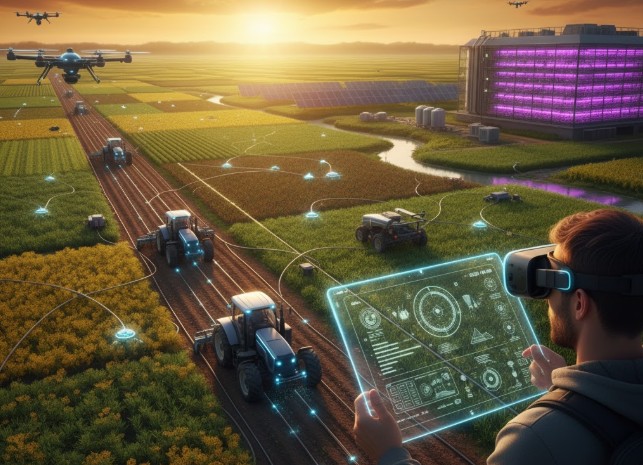
Agriculture has always been about timing, observation, and intuition. Farmers once relied solely on experience to predict weather, choose seeds, or manage water. But today, the story has changed. The rise of precision agriculture technology has transformed farming into a science powered by data. It’s no longer just about planting and harvesting—it’s about understanding every inch of soil, every drop of water, and every ray of sunlight.
Precision agriculture isn’t just a buzzword; it’s a reality reshaping how farmers grow food. It combines advanced tools like sensors, drones, GPS, artificial intelligence, and data analytics to help farmers make smarter decisions. The goal is simple—produce more using fewer resources. In this article, we’ll dive deep into the fascinating world of technologies that make precision farming possible.
1. The Core of Precision Agriculture: Data-Driven Decision Making
At its heart, precision agriculture technology thrives on data. Imagine having a map of your farm that shows soil moisture, nutrient levels, and crop health in real time. That’s what modern data systems can do. Every sensor, satellite, and drone acts as a tiny observer, collecting valuable information that helps farmers plan better.
This data-driven approach lets farmers know exactly when and where to irrigate, fertilize, or harvest. It’s like giving the soil and plants a voice, and listening closely to what they need. Instead of applying fertilizer evenly across a field, technology helps apply it only where necessary. This cuts waste, reduces costs, and protects the environment.
Here’s how it typically works:
- Sensors gather information about soil and crop conditions.
- Cloud platforms store and analyze the data.
- AI algorithms interpret results to provide insights.
- Farmers use mobile apps to make timely decisions.
With these tools, precision agriculture turns every farm into a smart ecosystem guided by information rather than guesswork.
Read More: Top 10 Technologies In Agriculture You Must See
2. GPS and GIS: The Invisible Hands Guiding Modern Tractors
When we think of precision, the first thing that comes to mind is accuracy—and that’s exactly what GPS (Global Positioning System) and GIS (Geographic Information Systems) bring to the table. In simple terms, GPS guides farm machinery, while GIS helps analyze spatial data.
Modern tractors are equipped with GPS-based auto-steering systems that can navigate with centimeter-level precision. That means fewer overlaps in plowing, seeding, or spraying—saving fuel, time, and money. GIS complements this by creating detailed maps that visualize everything from soil properties to crop yield differences across a field.
Imagine standing in a field and knowing that one section needs more nitrogen while another needs less water. GIS maps make that visible and actionable. The combination of GPS and GIS makes farming not only smarter but also more sustainable.
Key Benefits of GPS and GIS in Precision Agriculture:
- Reduced fuel consumption and labor costs.
- Optimized planting and spraying routes.
- Accurate field mapping and boundary identification.
- Improved yield monitoring and soil analysis.
Together, these technologies ensure that every movement on the farm counts, bringing efficiency and consistency to every step of cultivation.
3. Drones: The Eyes of the Modern Farmer
A decade ago, drones were seen as gadgets for hobbyists. Today, they are indispensable tools in precision agriculture. These flying devices capture high-resolution images and videos, giving farmers a bird’s-eye view of their fields. What once took hours to inspect on foot can now be done in minutes from the sky.
Drones equipped with thermal and multispectral cameras can detect crop stress, pest infestations, and irrigation issues before they become visible to the human eye. This means farmers can act early and prevent potential losses. Drones also help in seed planting, pesticide spraying, and even monitoring livestock.
Imagine this scenario: a farmer uses a drone to scan a 100-acre field. The drone identifies areas where crops are under stress due to water shortage. The farmer then adjusts irrigation precisely in those zones. That’s how drones make farming both efficient and environmentally responsible.
Advantages of Using Drones in Farming:
- Fast and accurate crop health assessment.
- Reduced inspection time and manual labor.
- Enhanced irrigation and pest control management.
- Real-time field monitoring for better decisions.
Drones bring the power of observation and precision right to the farmer’s fingertips, turning aerial data into actionable insights.
4. IoT and Smart Sensors: Farming That Thinks for Itself
The Internet of Things (IoT) is another key player in precision agriculture. IoT connects physical devices—like soil sensors, weather stations, and irrigation systems—through the internet. These devices continuously collect and share data, creating a living network that “thinks” for the farm.
For example, soil moisture sensors buried underground monitor how much water crops have. When the soil becomes too dry, the system automatically triggers irrigation. Similarly, temperature and humidity sensors can warn farmers of potential disease risks.
This kind of automation saves time, energy, and water. It ensures that crops get exactly what they need, when they need it. Farmers can monitor all this from their smartphones, even if they’re miles away from the field.
IoT Devices Commonly Used in Precision Agriculture:
| Device Type | Function | Benefit |
| Soil Sensors | Measure moisture and nutrient levels | Efficient irrigation and fertilization |
| Weather Stations | Track rainfall, wind, and temperature | Improved crop protection planning |
| GPS-Enabled Sprayers | Apply inputs with precision | Minimized chemical use |
| Automated Irrigation Systems | Water crops automatically | Water conservation |
IoT creates a connected farm where every element—from soil to sky—works together harmoniously to increase productivity and sustainability.
5. Artificial Intelligence and Machine Learning: The Mind of the Farm
If IoT provides the body, Artificial Intelligence (AI) provides the mind of precision agriculture. AI and machine learning interpret massive amounts of data to predict outcomes and suggest solutions. They turn raw information into practical insights that guide real-world farming decisions.
For example, AI models can analyze satellite images to predict crop yields or detect disease outbreaks early. Machine learning algorithms learn from patterns in past seasons, helping farmers forecast which crops will perform best under specific conditions.
AI-driven tools can even recommend the ideal planting schedule or the best fertilizer mix. The more data they process, the smarter they become. It’s like having a digital agronomist who never sleeps and keeps learning.
Practical Uses of AI in Precision Agriculture:
- Early pest and disease detection.
- Automated image analysis from drones and satellites.
- Predictive modeling for yield forecasting.
- Smart irrigation and resource optimization.
AI is reshaping the way farmers interact with the land. Instead of reacting to problems, they can now anticipate and prevent them.
6. Satellite Imagery: Watching Crops from Space
Satellite technology has become an integral part of precision agriculture. It allows large-scale monitoring that goes beyond what drones or ground sensors can achieve. With satellite imagery, farmers can assess crop health, soil conditions, and even predict harvests.
High-resolution images provide detailed insights into vegetation growth through indicators like NDVI (Normalized Difference Vegetation Index). This helps identify stress areas that might need more attention. By comparing images over time, farmers can see how different parts of their fields respond to treatments or weather changes.
For big farms spread across several acres, satellites are invaluable. They save countless hours of manual inspection and help manage operations with accuracy.
Benefits of Satellite Imagery:
- Wide-area monitoring with consistent data.
- Long-term analysis of crop growth patterns.
- Integration with AI for predictive analysis.
- Support for environmental sustainability programs.
By connecting outer space with the earth beneath our feet, satellites make it possible to manage farms at a level of precision that once seemed impossible.
7. Robotics and Automation: The Future of Hands-Free Farming
The next step in precision agriculture technology is automation. Robots are taking over repetitive and labor-intensive tasks like weeding, harvesting, and spraying. These machines don’t tire, make fewer mistakes, and can work around the clock.
Agricultural robots use sensors, cameras, and AI to identify plants, distinguish between crops and weeds, and apply treatments precisely. Some robots even use machine vision to pick fruits at the perfect ripeness, ensuring high quality and reducing waste.
In many developed regions, robotic systems are addressing labor shortages and improving efficiency. For instance, autonomous tractors can plant seeds in straight lines without human control, and robotic sprayers can treat only infected plants instead of entire fields.
Advantages of Robotics in Agriculture:
- Reduced labor dependency.
- Enhanced precision and productivity.
- Lower operational costs.
- Safer chemical handling and application.
Automation is not replacing farmers—it’s empowering them to focus on strategy, innovation, and sustainable growth.
8. Big Data and Cloud Computing: The Brain Behind Smart Farms
Data collected from sensors, drones, and satellites is enormous. To manage it effectively, farmers rely on big data analytics and cloud computing. These systems store, process, and interpret massive amounts of information in real time.
Cloud-based platforms allow farmers to access insights anywhere—on their phone, tablet, or computer. They can compare data from multiple seasons, analyze trends, and make smarter investment decisions. Big data also helps in climate modeling and predicting future risks like droughts or pest outbreaks.
In essence, data is the new fertilizer for the digital farm. It nurtures smarter decisions and sustainable growth.
Benefits of Big Data in Precision Agriculture:
- Real-time monitoring and analysis.
- Better resource management.
- Historical data comparison for long-term planning.
- Improved traceability and transparency in food production.
With the cloud connecting every element of the farm, precision agriculture becomes not just a method—but a mindset of continuous improvement.
9. Sustainable Impact: How Precision Agriculture Protects the Planet
Beyond boosting productivity, precision agriculture technology is about responsibility. It minimizes resource waste, reduces environmental impact, and promotes sustainable farming practices. Farmers can now use water, fertilizers, and pesticides more efficiently, cutting costs and protecting soil health.
By targeting specific areas instead of entire fields, pollution from runoff decreases significantly. Drones and sensors also help detect early pest infestations, reducing the need for blanket chemical sprays. Over time, this approach restores soil fertility and maintains ecological balance.
In short, precision agriculture aligns technology with nature, ensuring that progress doesn’t come at the planet’s expense.
Conclusion: A Smarter, Sustainable Future for Farming
The technologies behind precision agriculture—from GPS and drones to AI and IoT—are not just innovations; they’re lifelines for modern farming. They bridge tradition with technology, empowering farmers to produce more while preserving the environment.
The journey ahead will see even more integration, where smart systems predict, adapt, and learn in real time. Farming is no longer about reacting—it’s about anticipating. Precision agriculture turns every challenge into an opportunity and every decision into a data-backed success.
In the end, it’s not just about growing crops; it’s about growing smarter, cleaner, and more connected to the land that feeds us all.
