


In the evolving world of digital education, one name that consistently catches attention is Data Flair. Over the past few years, this platform has become a well-known hub for learners who want to gain practical knowledge in technology, data analytics, software development, and more. What makes Data Flair stand out isn’t just the variety of courses it offers but its approach—one that emphasizes real-world application, hands-on projects, and guidance from experienced mentors. In 2025, as online education continues to dominate learning trends, understanding platforms like Data Flair becomes essential for students and professionals looking to enhance their skills and advance their careers.
This detailed article explores the real experiences of learners who have interacted with Data Flair, including the positives, negatives, and everything in between. Whether you’re a student exploring your first course, a working professional hoping to upskill, or simply curious about how this platform compares to others, this honest analysis will help you make an informed decision. Let’s dive into what Data Flair truly offers and what makes it so talked about in the e-learning space.
What is Data Flair? A Closer Look at the Platform
At its core, Data Flair is an online learning platform designed to make complex technical subjects easy to understand. It offers courses in areas like Python programming, Data Analytics, Power BI, Java, Web Development, and Artificial Intelligence. What separates Data Flair from many other platforms is its focus on project-based learning. Instead of just watching tutorials or reading slides, learners are encouraged to apply what they learn through practical assignments and case studies that mimic real-world challenges.
The teaching style is interactive and student-focused. Instructors—many of whom have professional experience in their fields—don’t just teach theory; they walk learners through the process of building and implementing solutions. This gives students a stronger sense of confidence and readiness for professional work. Another key attraction is that many of Data Flair’s courses are free or come at a very affordable price, which makes it accessible to learners from different backgrounds.
Moreover, Data Flair issues certificates upon completion, which can add value to a learner’s resume. These certifications often serve as proof of effort, consistency, and technical capability—qualities employers appreciate. The platform’s learning environment is structured, clear, and guided, ensuring that even beginners find it easy to navigate complex topics.
Why Learners Choose Data Flair: The Human Side of Learning

When analyzing reviews from real students, one thing stands out—the emotional connection many learners feel toward Data Flair. Students describe the experience not just as “educational” but as “transformative.” They highlight the simplicity of explanations, the helpful nature of instructors, and the satisfaction of completing a course that feels both manageable and challenging. In a world where online courses often feel impersonal, Data Flair brings a refreshing sense of mentorship and encouragement.
For instance, one reviewer described how they enjoyed the “easy-to-understand teaching style” that made even advanced topics like Python or Power BI approachable. Another student mentioned that Data Flair’s free courses gave them the opportunity to learn without worrying about financial barriers—a point that resonates deeply with learners from developing countries or students at early career stages.
Here are some of the reasons students often choose Data Flair:
- Affordable or free learning with professional-level content.
- Practical assignments and hands-on projects that simulate real-life tasks.
- Guidance from experienced mentors who are patient and approachable.
- Structured learning paths that make complex subjects easier to grasp.
- Certification opportunities that help boost resumes and career profiles.
This combination of affordability, accessibility, and authenticity has made Data Flair a trusted choice among beginners and intermediate learners alike. Students don’t just learn—they grow in confidence and build skills that translate directly into their professional lives.
The Strengths of Data Flair: Where It Shines Brightest
Every learning platform has its strong points, and Data Flair is no exception. What truly makes it shine is how it combines clarity, structure, and support in its approach to education. Many reviews praise the quality of teaching, emphasizing how instructors simplify even the most difficult topics. Learners repeatedly mention that Data Flair’s teaching methods are “clear,” “well-paced,” and “easy to follow.” This is especially beneficial for beginners who often feel overwhelmed when learning to code or analyze data.
Another key strength lies in its focus on practical skills. Instead of limiting students to theory, Data Flair integrates projects and exercises that replicate real-world challenges. For example, in courses like Data Analytics or Power BI, learners might be asked to create dashboards or analyze datasets that reflect real business scenarios. This helps bridge the gap between learning and doing—something many educational platforms struggle to achieve.
The instructors at Data Flair are also consistently praised. Their experience in industry roles adds credibility to their teaching. Instead of reading off a script, they share insights drawn from real projects, helping students understand not just “how” something works, but “why” it works that way. This mentor-like guidance turns learning into a collaborative experience rather than a one-sided lecture.
Finally, Data Flair’s customer support and responsiveness also earn appreciation. Many users have noted that they receive quick replies to their queries, and issues are resolved efficiently. In an age where online learners often feel left on their own, this personal touch adds tremendous value.
Where Data Flair Can Improve: Constructive Criticism from Students
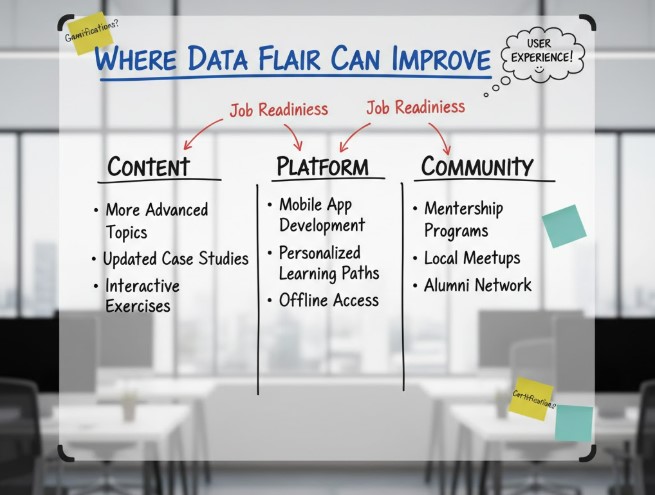
While Data Flair has earned praise from a majority of its users, it’s not without its flaws. Some reviewers express that certain modules feel a bit short or lack in-depth explanation of advanced topics. For instance, learners who already have intermediate knowledge of programming or analytics sometimes wish for longer sessions or more detailed exercises. This suggests that while Data Flair is excellent for beginners, advanced learners may need supplementary material to go deeper into complex subjects.
Another common point of feedback revolves around timing restrictions and course structure. A few learners mentioned that courses have time-bound modules or progress limitations. While these controls are designed to prevent learners from rushing through content, some students prefer more flexibility in managing their pace. Additionally, reviewers have mentioned that progress tracking tools could be improved to give clearer insights into what’s completed and what’s pending.
A small percentage of users also express frustration with certificate distribution processes, noting that reviews or feedback submissions are sometimes required before receiving completion certificates. While this is common in many learning platforms for quality assurance, it can occasionally feel inconvenient to learners who just want a seamless experience.
Still, even those who noted these drawbacks acknowledged that Data Flair offers substantial value—especially considering the affordability and the free learning opportunities available.
Data Flair’s Impact on Students’ Careers and Confidence
Beyond ratings and reviews, the true success of any learning platform lies in the impact it creates. For Data Flair, that impact is evident in the confidence students gain after completing courses. Many reviewers mention how their understanding of programming or data analytics improved drastically after joining the platform. Several students even share that they used their newly learned skills to start internships, contribute to work projects, or prepare for job interviews.
Courses like Python, Power BI, Java, and Data Analytics are particularly popular among job seekers. They help bridge the gap between academic learning and real industry requirements. By working on case studies and projects, students don’t just memorize concepts—they learn how to apply them effectively. This makes them more employable and better equipped to handle real-world problems.
Let’s look at a simple table summarizing some of the most commonly praised aspects and improvement areas based on student experiences:
| Category | Positive Highlights | Areas for Improvement |
|---|---|---|
| Course Quality | Clear, structured, and beginner-friendly | Some topics could be more advanced |
| Instructor Expertise | Helpful and knowledgeable mentors | Add more industry examples for deeper insight |
| Affordability | Free and low-cost learning options | Optional premium content could add more depth |
| Hands-on Projects | Real-world applications and practical training | Need more interactive practice sessions |
| User Experience | Smooth and organized learning environment | Progress tracking system can be improved |
| Certification Process | Recognized certificates with free access | Simplify the review-based certificate requirement |
This table reflects what students appreciate most and what Data Flair could refine to deliver an even better experience.
The Role of Data Flair in Shaping Future Learning Trends

In 2025, as online learning becomes an integral part of education and career development, Data Flair is playing a pivotal role in shaping this new landscape. The platform’s commitment to accessible education aligns perfectly with the global demand for flexible and affordable skill-building. Unlike traditional institutions, Data Flair removes barriers like location, high tuition fees, and rigid schedules. It gives learners the power to study at their own pace while gaining relevant industry knowledge.
What’s remarkable is how Data Flair blends traditional teaching values with modern technology. It doesn’t just deliver pre-recorded lectures; it fosters engagement through mentorship and feedback. Learners are not treated as numbers but as individuals with unique goals and learning speeds. This human touch—combined with the accessibility of online learning—creates an experience that feels personal, practical, and purposeful.
In essence, Data Flair is not just teaching skills; it’s building confidence. It’s helping people believe that learning complex technical topics is possible with the right guidance. This philosophy makes Data Flair not just a platform but a community where curiosity meets opportunity.
Data Flair Courses: Quality, Structure, and Learning Experience
When we talk about the quality of education on Data Flair, one thing becomes clear—it’s not about how many topics they cover, but how well they teach them. The platform’s approach is structured and practical, balancing theory with real-world application. Each course follows a consistent pattern: introduction to the concept, explanation of theory, practical demonstration, and then a hands-on project. This flow ensures that learners not only remember what they learn but understand how to apply it.
The Data Flair courses in Python, Power BI, and Java are among the most appreciated. Students often mention that these courses are clear, interactive, and beginner-friendly, which makes them accessible even for those who have no prior coding experience. Instructors use relatable examples—sometimes from everyday life—to explain programming logic or analytical processes. For example, in a Power BI session, students might learn how to analyze sales data from a fictional company, helping them connect technical skills with practical outcomes.
Another strong point is Data Flair’s course materials. Learners get access to well-organized notes, downloadable resources, and recorded sessions. This makes revision easy and helps those who prefer to learn at their own pace. Unlike platforms that overwhelm students with dense reading materials, Data Flair focuses on simplifying learning through concise explanations and step-by-step instructions. This clarity is what sets it apart in an increasingly crowded e-learning market.
That said, some advanced learners feel that while the courses are well-designed for beginners, they could be enhanced with more advanced case studies or additional modules for deeper understanding. Still, as a starting point, Data Flair’s course quality offers excellent value, combining simplicity with effectiveness.
Hands-On Learning: Turning Knowledge into Real-World Skills
One of the most defining features of Data Flair is its project-based learning approach. Instead of merely watching lectures, students work on real projects that replicate workplace scenarios. This hands-on experience helps learners bridge the gap between “knowing” and “doing.” Whether it’s building dashboards in Power BI, analyzing datasets in Python, or creating small applications in Java, students are encouraged to experiment, make mistakes, and learn through problem-solving.
This practical approach transforms abstract theory into tangible skill. For example, a learner who studies Python doesn’t just learn syntax—they build mini projects, write functions, and analyze data sets. Similarly, in a Power BI course, learners get to visualize business data, design interactive dashboards, and interpret patterns—all of which mirror real-world business tasks.
Students repeatedly mention in their reviews that this practical exposure builds confidence. Many even showcase their completed projects on professional platforms like LinkedIn, demonstrating not only their learning progress but also their growing technical portfolio. In today’s competitive job market, having such project-based experience is crucial. It tells employers that the learner can apply concepts independently and has a genuine grasp of the subject.
The idea behind Data Flair’s hands-on learning is simple: knowledge without practice is like a car without fuel. The platform ensures that learners don’t just understand what’s taught but can use it effectively to solve problems, which is what employers truly value.
Data Flair’s Teaching Philosophy: Mentorship Over Instruction
Another aspect that makes Data Flair stand out is its teaching philosophy. Rather than functioning as a passive online platform, it takes on the role of a mentor. The instructors don’t just deliver lectures—they guide learners, answer questions, and support them through challenges. Many students describe their teachers as approachable, patient, and genuinely invested in their success.
The founder and faculty team, often praised in reviews, are known for explaining even the toughest topics in simple terms. One reviewer mentioned how “every sentence was easy to understand,” while another said, “I finally understood Python after struggling with it for months.” These testimonials reflect the core value of the platform: clarity over complexity.
This teaching style is especially beneficial for first-generation learners or students transitioning from non-technical backgrounds. Instead of using jargon, mentors break concepts down step-by-step. For instance, rather than jumping straight into advanced programming, a Data Flair instructor might start with relatable examples—like comparing loops to everyday routines—to make learning intuitive.
Such empathy-driven teaching is rare in online education. It transforms the experience from an impersonal digital course into a guided learning journey. Learners don’t feel like they’re studying alone; they feel accompanied by someone who understands their pace and helps them grow at every step.
Data Flair vs Other Online Learning Platforms
The e-learning world is filled with big names like Coursera, Udemy, and edX. However, Data Flair has carved out its niche by offering something unique—personalization and affordability. While major platforms often focus on massive global audiences, Data Flair keeps its courses tailored to individuals who prefer a mentor-driven, interactive experience.
Here’s a simple comparison that illustrates where Data Flair stands out:
| Feature | Data Flair | Other Platforms (General) |
|---|---|---|
| Price | Many courses are free or low-cost | Most are paid; some offer limited free trials |
| Instructor Interaction | Direct mentor guidance and doubt sessions | Often limited to discussion forums |
| Focus Level | Beginner to Intermediate | Beginner to Advanced |
| Project-Based Learning | Strong focus on hands-on practice | Varies depending on course |
| Certification | Free and easy to obtain upon completion | Often paid or restricted |
| Course Accessibility | Flexible timing, downloadable resources | Mostly streaming-only content |
While platforms like Coursera offer degrees and specialized certifications, Data Flair’s strength lies in its accessibility and approachability. It’s ideal for learners who want to start small, learn fast, and apply knowledge immediately. This makes it especially popular among interns, students, and early-career professionals looking to build a solid foundation before diving into advanced studies.
Value for Money: Is Data Flair Worth It?
The question many learners ask before enrolling in an online course is—“Is it worth my time and money?” For Data Flair, the answer from most reviewers is a strong yes. The platform delivers far more than what one would expect at its price point. Many of its courses are completely free, while others are priced reasonably compared to global learning platforms.
Students consistently mention that the value for money is exceptional. They receive not just course videos but full access to notes, projects, and certificates, which can be used to strengthen resumes or LinkedIn profiles. The free certification courses in Python, Power BI, and Data Analytics are particularly appreciated by students in India and other developing countries where affordability plays a crucial role in education.
Even paid courses are often described as cost-effective, given the quality of mentorship, structured content, and career-relevant projects. One learner summed it up well, saying, “It’s rare to find courses that are so affordable and yet so well-structured. Data Flair gives you more than your money’s worth.”
In short, Data Flair offers a balance of accessibility and depth, which makes it a smart choice for budget-conscious learners who don’t want to compromise on quality.
Real Student Experiences: Success Stories and Honest Reflections
When you read through dozens of Data Flair reviews, a clear pattern emerges—students feel supported, empowered, and motivated. For many, this platform has been a turning point in their learning journey. Let’s look at a few summarized student experiences that highlight what Data Flair truly represents:
- Shubham, a beginner in programming, mentioned that the Python course helped him understand both theory and practice. He credited the clear explanations and real-world exercises for building his confidence.
- Neha, an engineering intern, appreciated how “lectures were easy to comprehend and the instructors knowledgeable.” She only wished for longer sessions to dive deeper into advanced concepts.
- Swapnil, from the telecommunications industry, described the interaction as “amazing,” appreciating the thoughtful design of the course modules and the simplicity of communication.
- Govind, a software trainee, expressed that “teachers were too interactive and helpful,” and every topic was taught in an easy format.
These testimonials reflect a strong sense of gratitude. Students don’t just see Data Flair as a platform—they see it as a community that believes in their potential. The small team size and personalized teaching methods make learners feel recognized and valued, not lost in a crowd.
Of course, there are mixed opinions too. Some students wanted more detailed modules or improvements in progress tracking, while a few raised concerns about the certificate process requiring review submissions. Yet, these issues were often mentioned alongside positive feedback, indicating that the overall experience outweighed the minor frustrations.
The Future of Learning with Data Flair
Looking ahead, Data Flair has the potential to become one of the most influential educational platforms for practical, skill-based learning. The demand for data-related careers—from analytics to AI—continues to grow rapidly. As companies seek professionals with both theoretical understanding and applied expertise, platforms like Data Flair are well-positioned to fill that gap.
The platform’s next step should focus on expanding its advanced course offerings, improving progress tracking features, and continuing to foster its interactive mentor-driven model. If it maintains its commitment to quality and affordability, Data Flair could easily become a leader in accessible online education.
Its future success will depend on how it continues to blend technology with empathy—delivering not just lessons, but life-changing learning experiences.
Final Verdict: A Reliable Start for Every Learner
To sum up, Data Flair stands as a strong example of what online education should look like—affordable, accessible, and authentic. It offers learners a space where they can start from scratch, gain practical knowledge, and grow both personally and professionally.
While it’s not perfect, its focus on clear teaching, hands-on practice, and mentorship makes it one of the most learner-friendly platforms in the current digital education landscape. For beginners or those looking to upskill without financial stress, Data Flair is definitely worth considering.
Frequently Asked Questions (FAQs)
1. What is Data Flair?
Data Flair is an online education platform that offers free and paid courses in fields like Python, Power BI, Data Analytics, Java, and more. It focuses on hands-on learning and project-based education.
2. Are Data Flair courses free?
Yes, many Data Flair courses are free. They also provide certificates upon completion, making it an excellent choice for learners on a budget.
3. Are Data Flair certificates valid for jobs?
While Data Flair certificates are not government-accredited, they are recognized by employers as proof of skill development and hands-on training, especially for entry-level roles.
4. How are the instructors at Data Flair?
Students often describe the instructors as knowledgeable, patient, and approachable. Their teaching style focuses on clarity and real-world understanding.
5. Can beginners learn programming from Data Flair?
Absolutely. Data Flair is particularly popular among beginners because its teaching approach is simple, structured, and supportive.
6. Does Data Flair offer placement assistance?
While Data Flair doesn’t guarantee jobs, it equips learners with practical skills and projects that improve employability and career readiness.
7. What are the most popular courses on Data Flair?
The most in-demand courses include Python Programming, Power BI, Data Analytics, and Java—all designed to meet industry needs.
8. Is Data Flair trustworthy?
Yes. Based on numerous positive student reviews, Data Flair is a legitimate and reliable platform with a genuine focus on learning and skill-building.
Conclusion
In a digital era where education has gone global, Data Flair stands out for keeping learning simple, human, and effective. It’s not just another course provider—it’s a bridge between curiosity and capability. Whether you’re a student eager to start coding or a professional looking to enhance your analytical skills, Data Flair offers the perfect blend of affordability, mentorship, and practical knowledge.
It proves that quality education doesn’t need to be expensive or intimidating—it just needs to be sincere.
