

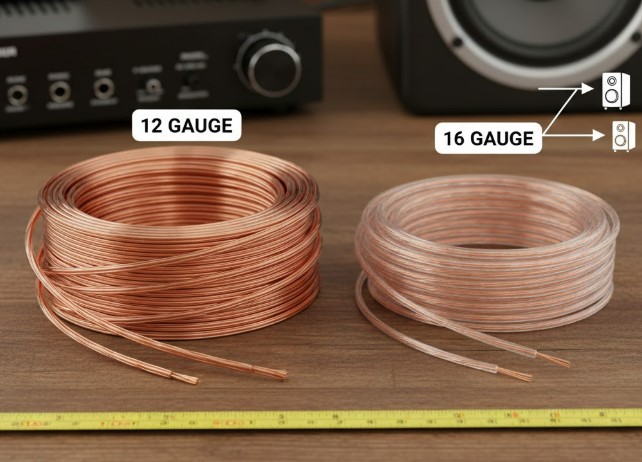
12 gauge vs 16 gauge speaker wire: The best choice depends on your speaker system’s power and distance, with 12 gauge generally offering superior sound quality for longer runs and higher power by minimizing signal loss.
Key Takeaways
- Choose 12 gauge for longer distances and powerful speakers.
- Opt for 16 gauge for shorter runs and less demanding systems.
- Thicker wire (lower gauge number) reduces signal loss.
- Consider amplifier wattage and speaker impedance.
- Proper wiring ensures optimal audio performance.
12 Gauge Vs 16 Gauge Speaker Wire: Which Is Best for Your Audio Setup?
As an audiophile or even just someone who enjoys good sound, you might find yourself at a crossroads when it comes to speaker wire. It’s not as simple as grabbing the first spool you see. Two common options, 12 gauge and 16 gauge speaker wire, often lead to the question: “12 gauge vs 16 gauge speaker wire, which is best?” This can be confusing, especially for beginners.
The truth is, the “best” wire isn’t a one-size-fits-all answer. It hinges on a few key factors related to your audio system. But don’t worry! This guide will break down the differences between 12 gauge and 16 gauge speaker wire in a simple, step-by-step way. By the end, you’ll have the confidence to choose the right wire for your speakers and enjoy clearer, more powerful sound.
Understanding Speaker Wire Gauges
Before we dive into the 12 gauge vs 16 gauge debate, let’s quickly touch on what “gauge” means when it comes to wire. In the United States, the gauge system for electrical wire is a bit counter-intuitive: the lower the gauge number, the thicker the wire. Think of it like this: a #12 is thicker than a #16.
Why does thickness matter for speaker wire? It all comes down to resistance. Thicker wires have less resistance, which means they can carry electrical signals (your audio signal) more efficiently. Less resistance means less signal loss, and less signal loss translates to better sound quality – clearer highs, tighter bass, and a more dynamic listening experience. This is a fundamental principle in electrical engineering, as explained by the U.S. Department of Energy.
12 Gauge Speaker Wire: The Heavyweight Champion
When you’re looking at 12 gauge vs 16 gauge speaker wire, 12 gauge is the thicker option. Its lower gauge number means it has a larger diameter.
Benefits of 12 Gauge Wire
- Reduced Signal Loss: Due to its larger diameter, 12 gauge wire offers lower resistance. This is crucial for maintaining the integrity of your audio signal, especially over longer distances.
- Better for High Power Systems: If you have powerful amplifiers and speakers that demand a lot of energy, 12 gauge wire can handle the load more effectively without overheating or causing performance issues.
- Superior Bass Response: The reduced signal loss can lead to tighter, more defined bass, as the amplifier’s signal reaches the speaker with less degradation.
- Future-Proofing: Investing in 12 gauge wire now might be beneficial if you plan to upgrade to more powerful audio equipment in the future.
When to Choose 12 Gauge
You should seriously consider 12 gauge speaker wire if:
- Your speaker wire runs are longer than 50 feet (approximately 15 meters).
- You are using high-powered receivers or amplifiers (typically over 100 watts per channel).
- You have speakers with a lower impedance (such as 4 ohms), as these draw more current and benefit from lower resistance wiring.
- You prioritize the best possible sound quality and want to minimize any potential signal degradation.
16 Gauge Speaker Wire: The Versatile All-Rounder
On the other side of the 12 gauge vs 16 gauge discussion is 16 gauge speaker wire. It’s thinner than 12 gauge, meaning it has a higher resistance.
Benefits of 16 Gauge Wire
- Cost-Effective: Generally, 16 gauge wire is less expensive than 12 gauge wire, making it a budget-friendly option.
- Easier to Handle: Its thinner profile can make it easier to route and conceal, especially in tight spaces or during installation.
- Sufficient for Many Setups: For moderate setups with shorter wire runs, 16 gauge provides perfectly adequate performance.
When to Choose 16 Gauge
16 gauge speaker wire is a good choice for you if:
- Your speaker wire runs are relatively short, typically under 50 feet (around 15 meters).
- You are using moderate-powered amplifiers and speakers (under 100 watts per channel).
- Your speakers have a standard impedance (like 8 ohms) and your amplifier isn’t exceptionally powerful.
- You are setting up a simpler home audio system, perhaps for a secondary room or a basic surround sound setup.
12 Gauge vs 16 Gauge Speaker Wire: A Direct Comparison
To make the decision even clearer, let’s put 12 gauge and 16 gauge speaker wire side-by-side.
| Feature | 12 Gauge Speaker Wire | 16 Gauge Speaker Wire |
|---|---|---|
| Wire Thickness | Thicker (lower gauge number) | Thinner (higher gauge number) |
| Resistance | Lower | Higher |
| Signal Loss | Minimal | Slightly more noticeable over distance |
| Best For | Long runs (>50 ft), high-power systems, low impedance speakers | Short runs (<50 ft), moderate power systems, standard impedance speakers |
| Cost | More expensive | Less expensive |
| Installation Ease | Slightly stiffer, can be harder to route | More flexible, easier to route |
Factors That Influence Your Choice
When deciding between 12 gauge vs 16 gauge speaker wire, consider these critical elements:
1. Wire Run Length
This is perhaps the most significant factor. The longer the wire, the more electrical resistance it encounters. According to Crutchfield, a leading audio retailer, “The longer the wire run, the thicker the gauge must be to minimize signal loss.” For runs over 50 feet, 12 gauge wire is almost always recommended to prevent audible degradation. For shorter runs, 16 gauge is often sufficient.
2. Amplifier Wattage
The power output of your amplifier plays a direct role in how much current your speakers will draw. Higher wattage amplifiers push more power, and thicker wires (like 12 gauge) are better equipped to handle this without introducing resistance that can affect performance. As a general guideline, for amplifiers over 100 watts per channel, leaning towards 12 gauge is a wise move.
3. Speaker Impedance
Speaker impedance is measured in ohms (Ω) and represents the speaker’s resistance to the electrical current. Most home speakers are rated at 8 ohms, but some, especially high-performance or car audio speakers, can be as low as 4 ohms or even 2 ohms. Lower impedance speakers draw more current, making them more susceptible to signal loss from thinner wires. If you have 4-ohm speakers, especially with a powerful amplifier, 12 gauge wire is highly recommended.
4. Sound Quality Goals
If you’re an audiophile who strives for the absolute best sound reproduction, investing in 12 gauge wire is often a non-negotiable step. It ensures that the pristine signal from your amplifier makes it to your speakers with minimal distortion or loss of detail, particularly in the bass frequencies. Even if your current setup might technically “work” with 16 gauge, 12 gauge offers a noticeable improvement in clarity and impact for discerning listeners.
Understanding Wire Gauge and Resistance
The relationship between wire gauge and resistance is fundamental to understanding why 12 gauge vs 16 gauge speaker wire matters. Resistance in a wire causes a portion of the electrical signal to be converted into heat rather than reaching the speaker. This results in a weaker signal, especially at higher frequencies, and can lead to a loss of dynamic range and detail.
Here’s a simplified look at how resistance varies:
| Gauge | Diameter (mm) | Resistance (Ohms per 100ft) |
|---|---|---|
| 10 Gauge | 2.588 | 0.099 |
| 12 Gauge | 2.053 | 0.157 |
| 14 Gauge | 1.628 | 0.249 |
| 16 Gauge | 1.291 | 0.395 |
| 18 Gauge | 1.024 | 0.628 |
Source: Based on standard AWG (American Wire Gauge) data. Resistance can vary slightly based on conductor material purity and temperature.
As you can see from the table, 12 gauge wire has significantly lower resistance than 16 gauge wire. This lower resistance is the key to its superior performance in demanding audio applications.
Pro Tip: Don’t Forget Copper Purity and Stranding
While gauge is king, the quality of the copper and how it’s stranded also matters. Look for “Oxygen-Free Copper” (OFC) for better conductivity. Also, stranded wire is generally preferred over solid-core wire for audio applications because it’s more flexible and less prone to breaking with movement, which is common behind speakers and audio equipment.
Installation Tips for Speaker Wire
No matter which gauge you choose, proper installation ensures you get the most out of your speaker wire.
Connecting the Wire
Most modern receivers and speakers use binding posts or spring clips. Ensure you connect the wire securely. For binding posts, bare wire is common. Twist the strands tightly before inserting them, and then tighten the post. If using banana plugs or spade connectors, ensure they are crimped or soldered securely to the wire.
Polarity Matters!
It is absolutely critical to maintain correct polarity. This means connecting the positive (+) terminal on your amplifier to the positive (+) terminal on your speaker, and the negative (-) terminal on your amplifier to the negative (-) terminal on your speaker. Most speaker wire has some indicator on one of the conductors (like a stripe, ridge, or different color insulation) to help you identify the positive wire. If you get polarity wrong, your speakers will play out of phase, leading to a thin sound and poor bass response. This is a common mistake beginners make.
Securing the Wire
For in-wall installations or runs along baseboards, use appropriate cable management clips or staples designed for low-voltage wire. Never staple speaker wire directly, as you could damage the insulation and cause a short circuit. For runs across floors, use floor cord covers to prevent tripping hazards and protect the wire.
When 16 Gauge is Perfectly Fine
Let’s reiterate: for many common home audio setups, 16 gauge wire is more than adequate. If you have a standard bookshelf speaker setup connected to a modest receiver in a small to medium-sized room, and the wire runs are under 50 feet, you’re unlikely to hear a significant difference between 16 gauge and 12 gauge. The cost savings and ease of installation with 16 gauge can make it the practical choice.
When 12 Gauge is a Clear Winner
Conversely, if you’re setting up a dedicated home theater with large floor-standing speakers, a powerful AV receiver, or running wires through walls over significant distances, the benefits of 12 gauge wire become much more pronounced. The investment in thicker wire pays dividends in terms of preserving audio fidelity, ensuring your powerful equipment can drive your speakers effectively without being hampered by the wiring.
Frequently Asked Questions (FAQs)
Q1: Can I use 12 gauge wire for short runs?
Yes! Using 12 gauge wire for short runs is perfectly fine. It simply offers even better performance by further minimizing resistance, though the audible improvement might be negligible in very short distances.
Q2: Will 16 gauge wire damage my speakers or amplifier?
Generally, no. As long as the 16 gauge wire is of decent quality and has sufficient insulation, it won’t directly damage your equipment. However, it might result in slightly compromised sound quality due to increased resistance, especially with high-power systems or long runs.
Q3: How do I know the wattage of my amplifier?
Your amplifier’s manual or a sticker on the back of the unit will usually specify its power output per channel, typically measured in watts per channel (WPC). For example, “100WPC @ 8 ohms.”
Q4: What is impedance and why does it matter for speaker wire?
Impedance (measured in Ohms, Ω) is the opposition to electrical current flow. Lower impedance speakers draw more current from the amplifier. Thinner wires (higher gauge) have higher resistance, which can be problematic when delivering a high current demanded by low-impedance speakers, leading to signal loss or even potential amplifier strain.
Q5: What does “OFC” mean on speaker wire?
OFC stands for Oxygen-Free Copper. This indicates that the copper used in the wire has had most of its oxygen and impurities removed during manufacturing. OFC copper is a better conductor of electricity, leading to less signal loss and improved audio performance compared to standard copper.
Q6: Is it okay to mix 12 gauge and 16 gauge wire in different parts of my system?
It’s best to use the same gauge wire for all speakers connected to a single amplifier for consistent performance. If you must use different gauges, ensure the longer runs and higher-powered speakers get the thicker 12 gauge wire.
Conclusion: Making the Right Choice for Your Ears
Deciding between 12 gauge vs 16 gauge speaker wire ultimately comes down to matching the wire to your specific audio setup. For shorter runs and less demanding systems, 16 gauge offers a great balance of performance and affordability. However, for longer distances, high-powered amplifiers, or if you’re striving for the pinnacle of audio fidelity, 12 gauge speaker wire is the superior choice.
Don’t let the technical details intimidate you. By considering your wire run length, amplifier wattage, and speaker impedance, you can confidently select the right gauge of speaker wire. A little attention to detail here can make a significant difference in the clarity, power, and overall enjoyment of your music and movies. Happy listening!
