


Have you ever wondered how Netflix knows exactly what movie you’d love next or how your smartphone can recognize your face in seconds? Behind all these intelligent systems lies one powerful concept — machine learning. In simple terms, machine learning is a branch of Artificial Intelligence (AI) that allows computers to learn from data, identify patterns, and make decisions without being explicitly programmed for every scenario.
Imagine teaching a child to identify a cat by showing hundreds of cat pictures. Over time, the child learns to recognize cats even in new photos. Similarly, in a machine learning tutorial, computers learn from examples (data) to make predictions or classifications. The more they learn, the smarter they become.
This machine learning tutorial will walk you through the foundations of ML, including its types, workflow, popular algorithms, and how to deploy real-world models. By the end, you’ll understand how machines learn, think, and make decisions—just like humans, but faster and at scale.
Why Learn Machine Learning Today?
The world is driven by data. Every click, swipe, and search adds to the billions of data points created daily. Businesses across industries — healthcare, finance, retail, and even education — are using machine learning to make sense of this massive data.
Learning machine learning is no longer just for computer scientists. It’s a valuable skill for anyone who wants to future-proof their career. Here’s why it matters:
- Automation and Accuracy: ML models automate tasks and improve precision beyond human capabilities.
- Predictive Power: Forecasting market trends, weather, or even disease outbreaks is possible with ML.
- Data-Driven Decision Making: Companies rely on machine learning to guide strategic decisions.
- High Career Growth: Data scientists, ML engineers, and AI specialists are among the most in-demand professionals globally.
In short, understanding ML gives you a competitive edge — it’s like learning the language of the future.
Machine Learning Basics: Learning to Think Like a Machine
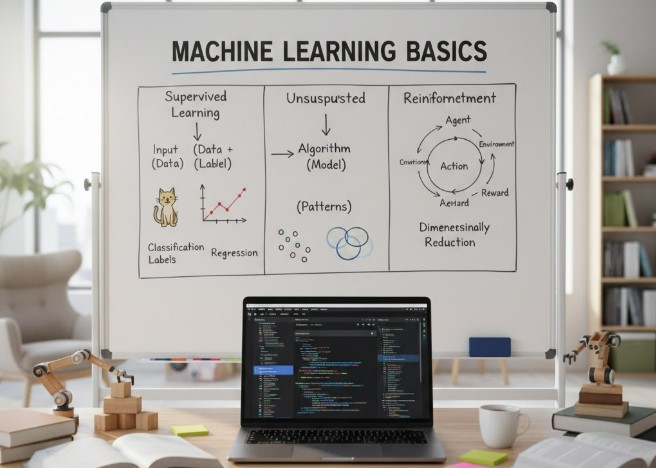
At its core, machine learning revolves around one simple principle — learning from data. Unlike traditional programming where you write rules and logic manually, ML systems find patterns in data and make predictions.
The process works like this:
- You provide data (input).
- The machine learns relationships or patterns from that data.
- The machine makes predictions or decisions based on what it has learned.
There are five main types of machine learning:
| Type | Description | Example |
|---|---|---|
| Supervised Learning | Trains models using labeled data (data with known outcomes). | Predicting house prices |
| Unsupervised Learning | Finds hidden patterns in unlabeled data. | Customer segmentation |
| Reinforcement Learning | Learns by trial and error through rewards and penalties. | Game-playing AI |
| Semi-Supervised Learning | Uses a mix of labeled and unlabeled data for training. | Fraud detection |
| Self-Supervised Learning | Models create their own labels from data. | Large language models like ChatGPT |
These learning types are the foundation of every ML application, from recommendation engines to self-driving cars.
Module 1: The Machine Learning Pipeline – From Raw Data to Smart Decisions

Before any machine can learn, it needs clean, organized, and well-prepared data. That’s where the machine learning pipeline comes in. Think of it as the journey that data takes — from raw input to a polished, deployable model.
1. Data Preprocessing – Cleaning the Mess
Raw data is messy. It often contains missing values, duplicates, and irrelevant features. Data preprocessing involves cleaning, transforming, and preparing data so the model can understand it.
Key steps include:
- Data Cleaning: Removing noise, outliers, and duplicates.
- Feature Scaling: Standardizing numerical features for uniformity.
- Feature Engineering: Creating new features to improve model performance.
- Feature Selection: Choosing only the most relevant features to reduce complexity.
A well-preprocessed dataset can make a simple model perform like a powerful one.
2. Exploratory Data Analysis (EDA) – Discovering the Story Behind Data
Once the data is clean, the next step is to understand it. Exploratory Data Analysis (EDA) helps you visualize trends, identify correlations, and uncover hidden patterns.
For instance, you might use scatter plots, histograms, or box plots to see how features relate to each other.
In Python, libraries like Pandas, Matplotlib, and Seaborn make EDA easier. Through visualization, you can detect relationships that numbers alone can’t show. For example, if sales rise with temperature, you can infer that ice cream sells better on hot days.
EDA is like detective work — it helps you uncover the data’s hidden story before feeding it into a model.
3. Model Evaluation – Measuring How Well Machines Learn
Building an ML model is just the start; evaluating its performance is what ensures reliability. The model evaluation process checks how accurately a model predicts outcomes using metrics like:
- Confusion Matrix – To understand classification accuracy.
- Precision and Recall – To measure how well the model distinguishes between true positives and false negatives.
- F1-Score – Balances precision and recall.
- AUC-ROC Curve – Shows how well a model separates classes.
- Cross-validation – Ensures the model works well on unseen data.
Hyperparameter tuning helps optimize the model for maximum accuracy by fine-tuning parameters such as learning rate or depth of trees.
Model evaluation ensures you don’t just build a smart model — you build a trustworthy one.
Module 2: Supervised Learning – Teaching Machines with Labeled Data
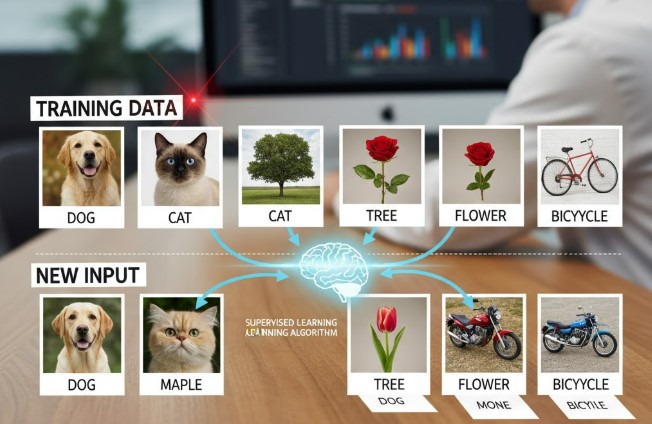
Supervised learning is the most popular and beginner-friendly type of machine learning. It’s like teaching a student with flashcards: you show inputs (features) and the correct answers (labels), and the model learns to map one to the other.
Supervised learning is divided into two categories:
- Classification – Predicting categories or labels (e.g., spam or not spam).
- Regression – Predicting continuous values (e.g., house prices).
Let’s break down the major algorithms that power this type of learning.
1. Linear Regression – The Simplest Predictor
Linear Regression is the foundation of most machine learning models. It finds the straight-line relationship between input features and an output variable. The goal is to predict continuous values such as sales or prices.
For example, if you want to predict house prices based on area and number of bedrooms, linear regression calculates the best-fit line that represents this relationship.
The key concept is gradient descent, which helps minimize prediction errors by adjusting weights gradually.
Though simple, linear regression forms the basis for more complex algorithms and helps you understand how models learn from numerical data.
2. Logistic Regression – Making Yes/No Predictions
Despite its name, logistic regression is used for classification, not regression. It predicts categorical outcomes such as “spam or not spam” or “pass or fail.”
It uses a mathematical function called the sigmoid function to map values between 0 and 1, representing probabilities. If the probability is above a threshold (say 0.5), it predicts one class; otherwise, another.
Logistic regression is easy to implement and interpret, making it ideal for beginners. It’s commonly used in healthcare, finance, and email filtering.
3. Decision Trees – Learning by Asking Questions
Decision Trees mimic human decision-making. Imagine a flowchart that asks a series of “yes” or “no” questions to reach an answer. That’s how this model works.
Each node represents a feature, and each branch represents a possible decision. For instance, if you’re classifying fruit, the tree might ask: “Is it round?” → “Yes.” → “Is it orange?” → “Yes.” → “Then it’s an orange.”
They’re easy to visualize and explain, making them popular for interpretability. However, they can overfit, so techniques like Random Forest or pruning help control complexity.
4. Support Vector Machines (SVM) – Drawing Boundaries with Precision
Support Vector Machines are powerful algorithms that find the best possible boundary (called a hyperplane) between different classes in your data.
Imagine you have two types of dots on a paper — red and blue. SVM tries to draw a line that perfectly separates them while keeping the maximum distance from both sides. This distance is called the margin, and maximizing it improves accuracy.
SVMs work well for both linear and non-linear problems using techniques like kernel tricks. They are often used in text classification, handwriting recognition, and bioinformatics.
5. k-Nearest Neighbors (k-NN) – Learning by Example
The k-Nearest Neighbors (k-NN) algorithm is one of the simplest ways to make predictions. Instead of building a model, it simply stores all training data. When a new data point appears, it looks for the k closest points and predicts based on their majority label.
For example, if most of the nearest neighbors are “cats,” the new image will be classified as a cat.
It’s intuitive and effective for small datasets but can become slow with large data. Still, for beginners, it’s a great way to understand similarity-based learning.
6. Naïve Bayes – Fast and Probabilistic
The Naïve Bayes algorithm is based on Bayes’ Theorem, which calculates probabilities for different outcomes. Despite its “naïve” assumption that features are independent, it performs surprisingly well — especially for text and spam detection.
Variants include Gaussian, Multinomial, and Bernoulli Naïve Bayes, each suited for different types of data. For instance, Multinomial NB works well for word frequency-based text data.
Its strength lies in speed, simplicity, and accuracy even with small datasets — a great reason it’s still used in email filtering and sentiment analysis.
7. Random Forest – The Power of Many Trees
When one tree isn’t enough, you grow a forest. Random Forest combines multiple decision trees (a process called bagging) to create a stronger, more reliable model.
Each tree is trained on a random subset of data, and their predictions are averaged (for regression) or voted (for classification). This reduces overfitting and improves accuracy.
Random Forests are versatile, handle both categorical and numerical data, and provide feature importance scores — helping you understand which variables impact predictions most.
Module 3: Unsupervised Learning – Discovering Hidden Patterns
If supervised learning is about teaching with labels, unsupervised learning is like exploring an unknown city without a guide. You don’t have labels or predefined outcomes; instead, the machine finds patterns, relationships, and structures on its own.
Unsupervised learning is especially useful when labeling data is too expensive or time-consuming. It’s commonly used in customer segmentation, anomaly detection, and recommendation systems.
There are three main branches: clustering, association rule mining, and dimensionality reduction.
1. Clustering – Grouping Similar Data Together
Clustering algorithms group similar data points based on features. They help uncover natural groupings within data that might not be obvious.
For example, an e-commerce company can group customers into “bargain hunters,” “frequent buyers,” and “occasional shoppers.”
Popular clustering methods include:
- K-Means Clustering: Divides data into k groups based on feature similarity.
- Hierarchical Clustering: Builds a tree-like structure of nested clusters.
- DBSCAN: Groups data based on density and identifies noise or outliers.
Clustering helps businesses personalize marketing, detect fraud, and understand complex datasets without predefined categories.
2. Dimensionality Reduction – Simplifying Complexity
Imagine trying to analyze a dataset with hundreds of variables — it’s overwhelming. That’s where dimensionality reduction comes in. It simplifies data by reducing the number of features while retaining essential information.
Common techniques include:
- PCA (Principal Component Analysis) – Transforms data into fewer uncorrelated variables.
- t-SNE (t-Distributed Stochastic Neighbor Embedding) – Great for visualizing high-dimensional data in 2D or 3D.
- NMF (Non-negative Matrix Factorization) – Useful for text data and image processing.
By removing redundant features, dimensionality reduction speeds up training and improves model performance. It’s like decluttering a room — fewer items, but everything you need remains.
3. Association Rule Mining – Finding Relationships in Data
Association rule mining finds hidden relationships between items in large datasets. It’s often used in market basket analysis, where stores learn that customers who buy bread also tend to buy butter.
Three key algorithms are:
- Apriori Algorithm – Identifies frequent item sets using minimum support thresholds.
- FP-Growth – Faster and more memory-efficient than Apriori.
- ECLAT – Uses intersection-based approaches for large-scale data.
These techniques are not limited to retail; they’re used in healthcare, finance, and cybersecurity to uncover dependencies and correlations that humans might overlook.
Module 4: Reinforcement Learning – Learning by Doing
Reinforcement Learning (RL) is inspired by how humans learn through experience. The model (called an agent) interacts with its environment, takes actions, and learns from feedback in the form of rewards or penalties.
Think of a video game player learning to avoid obstacles and reach goals. Each success earns a reward, and each mistake costs points. Over time, the player improves — and so does the RL model.
Reinforcement learning is widely used in robotics, autonomous driving, finance, and game AI.
1. Model-Based Methods
These methods use an internal model of the environment to simulate outcomes and plan ahead.
Examples include:
- Markov Decision Processes (MDPs) – Define states, actions, and rewards mathematically.
- Bellman Equation – Calculates optimal values recursively.
- Value Iteration and Policy Iteration – Methods for finding the best strategy (policy).
Model-based RL is efficient but depends heavily on the accuracy of its environment model.
2. Model-Free Methods
When you don’t have a model of the environment, model-free methods let the agent learn directly from experience.
Popular techniques include:
- Q-Learning – Learns a value function to choose the best action for each state.
- SARSA (State-Action-Reward-State-Action) – Similar to Q-Learning but considers actual actions taken.
- Monte Carlo Methods – Learn from complete episodes of experience.
- Actor-Critic Algorithms – Combine policy-based and value-based learning for better results.
Reinforcement learning powers innovations like AlphaGo, which defeated human champions by learning strategies through millions of simulated games.
Module 5: Semi-Supervised Learning – The Best of Both Worlds
In real-world scenarios, having perfectly labeled data is rare. That’s where semi-supervised learning steps in — combining a small portion of labeled data with a large set of unlabeled data.
It’s like having a teacher (labeled data) guide you for the first few lessons, and then you practice independently (unlabeled data).
Common methods include:
- Self-training – The model learns from labeled data, then labels unlabeled data to expand its training set.
- Few-shot Learning – Trains models to learn from very few examples.
- Graph-Based Methods – Represent relationships between labeled and unlabeled data as nodes and edges.
Semi-supervised learning is valuable when manual labeling is costly — for example, medical image labeling or document classification. It bridges the gap between supervised and unsupervised techniques.
Module 6: Forecasting Models – Predicting the Future
Forecasting models use time series analysis to predict future trends based on past data. They’re essential in finance, economics, retail, and meteorology.
Imagine being able to predict next month’s sales, stock prices, or weather patterns. That’s what forecasting models do.
Key techniques include:
- ARIMA (Auto-Regressive Integrated Moving Average) – Analyzes past values to predict future points.
- SARIMA (Seasonal ARIMA) – Extends ARIMA by accounting for seasonality.
- Exponential Smoothing (Holt-Winters) – Weighs recent observations more heavily for faster adaptation.
Forecasting isn’t limited to numbers — it’s also used in demand prediction, supply chain optimization, and energy consumption planning. With accurate forecasts, businesses make proactive rather than reactive decisions.
Module 7: Deploying Machine Learning Models – From Notebook to Production
Building a machine learning model is just half the journey. The real impact begins when you deploy it so others can use it. Deployment makes your model accessible through applications, websites, or APIs.
1. Web App Deployment
Frameworks like Streamlit and Gradio allow developers to build user-friendly web interfaces for ML models.
For example:
- Streamlit – Ideal for quick prototypes.
- Gradio – Great for building interactive demos.
- Heroku or AWS – Used to host models online for public access.
2. API Deployment
APIs let other software systems communicate with your ML model. Common frameworks include:
- Flask – Lightweight and simple for small projects.
- FastAPI – Modern, fast, and production-ready for scalable systems.
This allows integration into real-world workflows such as chatbots, recommendation systems, or analytics dashboards.
3. MLOps – Managing Machine Learning in Production
MLOps combines Machine Learning and DevOps to automate model deployment, monitoring, and maintenance. It ensures your models stay reliable, updated, and efficient even as new data flows in.
Key practices in MLOps include:
- Continuous Integration (CI)
- Continuous Deployment (CD)
- Version Control for Models
- Automated Monitoring and Retraining
MLOps bridges the gap between development and real-world application, ensuring machine learning doesn’t just stay in labs — it powers live business systems.
Machine Learning vs Deep Learning – What’s Next?
Once you’re comfortable with machine learning, the next step is deep learning — a subfield of ML that uses neural networks to mimic the human brain. Deep learning models power image recognition, speech processing, and large-scale language models like GPT.
While machine learning relies on structured data and explicit features, deep learning can automatically extract patterns from raw data such as images, sound, or text.
If ML is about teaching a child basic arithmetic, deep learning is like training a scientist to solve advanced equations.
Practical Applications of Machine Learning
Machine learning is no longer limited to tech companies. Its applications are everywhere:
- Healthcare – Diagnosing diseases and predicting patient risks.
- Finance – Fraud detection and stock prediction.
- Retail – Personalized recommendations and customer segmentation.
- Transportation – Route optimization and self-driving vehicles.
- Education – Personalized learning and grading automation.
The future belongs to those who can combine data-driven thinking with machine learning skills to build intelligent solutions.
How to Get Started with Machine Learning
If you’re new to ML, start small and grow gradually. Here’s a simple roadmap:
- Learn Python – The most popular ML language.
- Study Statistics and Linear Algebra – Foundation of ML algorithms.
- Master Libraries – Such as NumPy, Pandas, Scikit-learn, TensorFlow, and PyTorch.
- Work on Projects – Start with beginner projects like sentiment analysis or stock price prediction.
- Participate in Competitions – Platforms like Kaggle help you learn from others.
Remember, learning ML isn’t a sprint — it’s a marathon. Consistency and curiosity are your best tools.
Frequently Asked Questions (FAQs)
1. What is Machine Learning in simple words?
Machine Learning is a field of AI that allows computers to learn from data without being explicitly programmed. It’s like teaching a system by showing examples rather than giving direct instructions.
2. What are the types of Machine Learning?
The main types are Supervised, Unsupervised, and Reinforcement Learning. Additional types include Semi-Supervised and Self-Supervised Learning.
3. What skills are needed to learn Machine Learning?
You should know basic programming (Python), statistics, linear algebra, and have problem-solving skills.
4. How is Machine Learning used in real life?
It’s used in spam detection, speech recognition, recommendation systems, medical diagnostics, and financial forecasting.
5. What’s the difference between AI and Machine Learning?
AI is the broader concept of machines mimicking human intelligence, while Machine Learning is a subset of AI that learns from data to make predictions or decisions.
6. Can I learn Machine Learning without coding?
While tools like Google AutoML allow beginners to experiment, understanding Python and ML fundamentals gives you deeper control and flexibility.
7. How long does it take to learn Machine Learning?
With consistent learning, you can grasp the basics in 3–6 months and master advanced concepts in about a year.
8. What’s next after Machine Learning?
After mastering ML, you can dive into Deep Learning, Natural Language Processing (NLP), and MLOps to build more advanced AI systems.
Conclusion: Shaping the Future with Machine Learning
Learning machine learning isn’t just about mastering algorithms — it’s about understanding how machines think, decide, and evolve. With the right guidance, this machine learning tutorial can be your first step into a world where data meets intelligence.
As you explore each module — from preprocessing to deployment — you’ll see how mathematics, coding, and creativity come together to solve real-world problems. Machine learning isn’t just a technology; it’s a mindset of continuous learning, experimentation, and innovation.
So start small, stay curious, and let your journey into machine learning transform not only your skills but also your perspective on what’s possible with data.
