

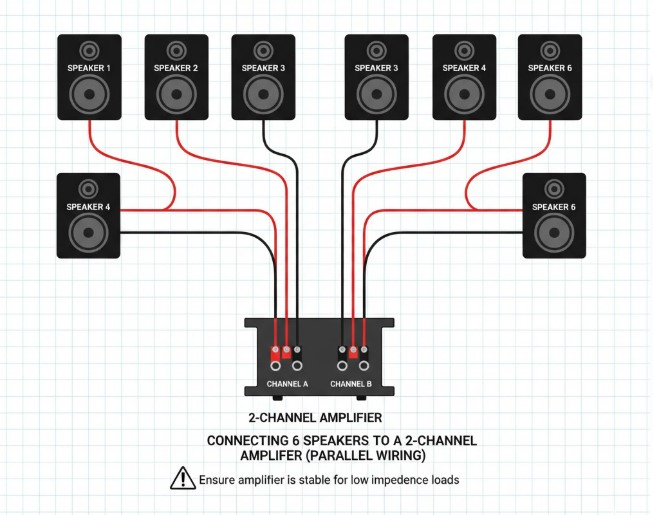
Connect 6 speakers to a 2-channel amp by wiring them in series-parallel. This balances impedance and ensures your amplifier can safely power all speakers for optimal sound.
Key Takeaways
Safely connect 6 speakers using series-parallel wiring.
Understand speaker impedance to avoid amp damage.
Calculate total impedance for your system.
Use appropriate gauge wires for secure connections.
Test your setup before full playback.
Have you ever found yourself with more speakers than amplifier channels and wondered, “How can I possibly connect 6 speakers to a 2-channel amp?” It’s a common situation for audio enthusiasts wanting to expand their sound system without buying a whole new amplifier. The good news is, it’s definitely doable! Many people think you need a multi-channel amp for more speakers, but with a bit of know-how about speaker wiring, you can achieve this. This guide will break down the process step-by-step, making it easy for beginners to understand and implement. We’ll dive into the concepts you need to know, like impedance, and show you exactly how to wire your speakers so they sound great and, more importantly, don’t damage your precious amplifier.
Understanding Speaker Impedance: The Crucial First Step
Before we get into the wiring itself, it’s vital to grasp the concept of speaker impedance. Impedance, measured in ohms (Ω), is essentially the resistance a speaker offers to the electrical current flowing through it from your amplifier. Think of it like traffic on a road; higher impedance means less traffic (resistance), allowing current to flow more easily. Lower impedance means more traffic, making it harder for the current to pass.
Your amplifier is designed to work with a specific range of impedance. Connecting speakers with too low an impedance can cause the amplifier to overheat, distort, or even suffer permanent damage because it’s being forced to push too much current. Conversely, connecting speakers with too high an impedance might result in a lower volume than expected, but it’s generally safer for the amp.
Most home audio amplifiers are designed to handle 4-ohm or 8-ohm speakers. It’s crucial to check your amplifier’s manual or its rear panel for its minimum impedance rating. For example, if your amp is rated for a minimum of 8 ohms, you cannot connect speakers that, when wired together, result in a total impedance lower than 8 ohms.
A single typical home speaker usually has an impedance of 8 ohms. Some can be 6 ohms or, more commonly in car audio, 4 ohms. Understanding the impedance of your specific speakers is the foundation for safely connecting multiple speakers to any amplifier, especially when trying to connect 6 speakers to a 2-channel amp.
Why Connecting Multiple Speakers Matters
Why would you want to connect 6 speakers to a 2-channel amplifier in the first place? There are several practical reasons:
- Whole-Home Audio: You might want to distribute sound throughout multiple rooms or zones in your house. A 2-channel amp could power the left and right channels for two different zones, for instance.
- Improved Soundstage: In some setups, especially larger rooms or home theaters, using more speakers can create a more immersive and expansive sound experience.
- Cost-Effectiveness: Instead of buying a new, more powerful multi-channel amplifier, you can often leverage existing equipment by carefully wiring additional speakers.
- Specific Speaker Placement: Sometimes, you need speakers in specific locations for optimal audio coverage that a simpler setup wouldn’t achieve.
The key to achieving these goals without risking your equipment lies in understanding how to combine speaker impedances correctly. This is where wiring configurations like series, parallel, and series-parallel come into play.
Speaker Wiring Configurations Explained
To successfully connect 6 speakers to a 2-channel amp, you’ll likely need to employ a combination of series and parallel wiring. Let’s break down these fundamental methods:
Parallel Wiring
In parallel wiring, you connect the positive (+) terminals of all speakers together and the negative (-) terminals of all speakers together. Then, you connect these combined positive and negative terminals to your amplifier’s corresponding output terminals. This method effectively divides the impedance. If you have two 8-ohm speakers wired in parallel, the total impedance is 4 ohms (8Ω / 2 speakers = 4Ω).
Formula for Parallel Wiring:
Total Impedance (Rtotal) = 1 / ( (1/R1) + (1/R2) + … + (1/Rn) )
For identical speakers:
Total Impedance (Rtotal) = R / n
Where R is the impedance of a single speaker and n is the number of speakers.
Pros: Maintains more consistent volume across speakers.
Cons: Dramatically lowers the total impedance, which can easily overload an amplifier not designed for low loads.
Series Wiring
In series wiring, you connect the positive (+) terminal of the first speaker to the amplifier’s positive output. Then, connect the negative (-) terminal of the first speaker to the positive (+) terminal of the second speaker, and so on. The negative (-) terminal of the last speaker is connected to the amplifier’s negative output. This method adds* the impedance together.
Formula for Series Wiring:
Total Impedance (Rtotal) = R1 + R2 + … + Rn
Pros: Increases the total impedance, making it safer for amplifiers that are sensitive to low loads.
Cons: If one speaker fails (e.g., a wire breaks), the entire circuit is broken, and no sound will come from any speaker in that series. Also, volume distribution can be uneven.
Series-Parallel Wiring (The Solution for 6 Speakers)
This is the technique you’ll likely use to connect 6 speakers to a 2-channel amp. It involves creating groups of speakers wired in series, and then connecting these groups in parallel. For example, you could wire three speakers in series on the left channel and another three speakers in series on the right channel. Then, you would wire these two series groups in parallel.
For our goal of 6 speakers (3 per channel), you would:
- Wire speakers 1, 2, and 3 in series for the left channel.
- Wire speakers 4, 5, and 6 in series for the right channel.
- Connect the series group for the left channel in parallel with the series group for the right channel.
Let’s illustrate this with an example. If you have three 8-ohm speakers wired in series, the total impedance for that group is 8Ω + 8Ω + 8Ω = 24Ω. If you then take two such 24-ohm series groups and wire them in parallel, the total impedance for the entire system becomes:
Rtotal = 1 / ( (1/24Ω) + (1/24Ω) ) = 1 / (2/24Ω) = 1 / (1/12Ω) = 12Ω.
This 12-ohm load is generally very safe for most stereo amplifiers.
How To Connect 6 Speakers To A 2 Channel Amp: Step-by-Step Guide
Now that you understand the concepts, let’s walk through the process. We’ll use the series-parallel method as it’s the most practical for connecting 6 speakers to a 2-channel amplifier while maintaining a safe impedance load.
Step 1: Gather Your Equipment
Ensure you have everything you need:
- Your 2-channel amplifier.
- The 6 speakers you want to connect.
- Quality speaker wire (appropriate gauge for the length and impedance – typically 14 or 16 gauge is sufficient for most home systems. For longer runs or lower impedances, consider 12 gauge. You can check resources like the Copper Development Association for guidance on wire gauge.)
- Wire strippers/cutters.
- Wire connectors (e.g., crimp connectors, Wago connectors, or terminal blocks), if not directly connecting bare wire.
- Screwdrivers or other tools needed to make connections at the amp and speakers.
Step 2: Determine Speaker Impedance and Amplifier Limits
This is critical. Check the back of each of your 6 speakers for their impedance rating (e.g., 8Ω, 6Ω, 4Ω). Also, find the minimum impedance rating for your amplifier. This is usually listed on the back panel or in the user manual. You can often find official documentation on the manufacturer’s website.
Example Scenario:
- You have 6 x 8-ohm speakers.
- Your amplifier’s minimum impedance is 4 ohms.
If you were to wire all 6 speakers in parallel, the impedance would be 8Ω / 6 = 1.33Ω, which would almost certainly damage a home amplifier rated for a minimum of 4 ohms. This highlights why series-parallel is often necessary.
Step 3: Plan Your Wiring Layout
For a 2-channel amp and 6 speakers, the most common and sensible approach is to divide the speakers into two groups of three, one group for each channel. You’ll wire each group of three speakers in series, and then connect these two series groups in parallel to the amplifier’s outputs.
Wiring Diagram Concept (using 8-ohm speakers):
- Left Channel:
- Amp (+) → Speaker 1 (+)
- Speaker 1 (-) → Speaker 2 (+)
- Speaker 2 (-) → Speaker 3 (+)
- Speaker 3 (-) → Amp (-)
This is a series connection for speakers 1, 2, and 3. The total impedance for this group is 8Ω + 8Ω + 8Ω = 24Ω.
- Right Channel:
- Amp (+) → Speaker 4 (+)
- Speaker 4 (-) → Speaker 5 (+)
- Speaker 5 (-) → Speaker 6 (+)
- Speaker 6 (-) → Amp (-)
This is a series connection for speakers 4, 5, and 6. The total impedance for this group is also 8Ω + 8Ω + 8Ω = 24Ω.
- Now, you have two 24Ω loads. The amplifier’s “Left” output will drive the first 24Ω series group, and the “Right” output will drive the second 24Ω series group. The amplifier sees two separate 24-ohm loads.
If your amplifier’s minimum is 4 ohms, this setup is perfectly safe. Most amplifiers are stable down to 4 ohms. If your amplifier is rated for 8 ohms minimum and you are using 8-ohm speakers, you might need a different configuration or more speakers. For instance, four 8-ohm speakers in series per channel would give 32 ohms per channel. Wiring two such groups in parallel would yield 16 ohms total per channel, which is extremely safe.
Step 4: Prepare Speaker Wires
Cut your speaker wire to the appropriate lengths. You’ll need:
- One wire from the amplifier’s Left (+) terminal to the first speaker (Speaker 1) of the left channel series group.
- Two wires connecting Speaker 1 (-) to Speaker 2 (+) and Speaker 2 (-) to Speaker 3 (+) within the left channel series group.
- One wire from the third speaker (Speaker 3) of the left channel series group to the amplifier’s Left (-) terminal.
- Repeat this for the right channel with speakers 4, 5, and 6.
Strip about half an inch (1 cm) of insulation from both ends of each wire. Ensure you keep track of which wire is positive (+) and which is negative (-) for each connection. Speaker wire usually has markings (a stripe, ribbing, or different colored conductor) to help distinguish polarity.
Step 5: Wire the Speakers (Series Groups)
Let’s focus on the left channel series group (Speakers 1, 2, 3):
- Connect the positive (+) terminal of Speaker 1 to the amplifier’s Left (+) output terminal using your prepared speaker wire.
- Connect the negative (-) terminal of Speaker 1 to the positive (+) terminal of Speaker 2.
- Connect the negative (-) terminal of Speaker 2 to the positive (+) terminal of Speaker 3.
- Connect the negative (-) terminal of Speaker 3 to the amplifier’s Left (-) output terminal.
Ensure all connections are secure. If your speakers have spring clips, insert the bare wire firmly. If they have binding posts, wrap the wire securely around them.
Repeat this exact process for the right channel with Speakers 4, 5, and 6, connecting them in series to the amplifier’s Right (+) and Right (-) terminals.
Step 6: Connect to the Amplifier
Double-check all your wiring from the steps above. Ensure polarity is correct: positive wires go to positive terminals, and negative wires go to negative terminals at both the speaker and amplifier ends.
Carefully connect the prepared wires to your amplifier’s speaker output terminals. If your amplifier uses binding posts, you might need to insert the bare wire ends and tighten the posts. If it uses spring clips, push the wire into the designated slot.
Important: Make sure no stray wire strands are touching adjacent terminals, as this can cause a short circuit.
Step 7: Test Your Setup
Before turning up the volume, perform a low-volume test:
- Turn your amplifier’s volume control all the way down.
- Turn on your amplifier.
- Play a piece of music at a very low volume.
- Check if sound is coming from all 6 speakers.
- Listen for any distortion or unusual noises.
- Gradually increase the volume slightly and continue listening. If you hear any problems, turn the volume down immediately and turn off the amplifier. Re-check all your connections and calculations.
If everything sounds good, you can gradually increase the volume to your desired listening level. Remember that running 6 speakers simultaneously will draw more power from your amplifier than running just one or two.
Calculating Total Impedance Made Easy
To help visualize and confirm your setup’s impedance, here’s a table showing common series-parallel configurations for 6 speakers, assuming 8-ohm speakers:
| Wiring Configuration | Impedance per Series Group | Total Impedance (Both Channels Combined) | Amplifier Safety (Min. Impedance) |
|---|---|---|---|
| 3 speakers in series per channel (2 groups total), wired in parallel to amp | 8Ω + 8Ω + 8Ω = 24Ω | 1 / ( (1/24Ω) + (1/24Ω) ) = 12Ω | Safe for amps rated down to 4Ω or 8Ω |
| 2 speakers in series per channel (2 groups total), each group wired in parallel with another 2-speaker series group (total 4 speakers total, 2 per channel). This setup would only use 4 speakers, not 6. | 8Ω + 8Ω = 16Ω | 1 / ( (1/16Ω) + (1/16Ω) ) = 8Ω | Very safe for amps rated down to 4Ω or 8Ω |
| 2 speakers in parallel per channel (2 groups total), each group wired in series with another 2-speaker parallel group (total 6 speakers). This is complex and not recommended for beginners. | 8Ω / 2 = 4Ω (parallel) | 4Ω + 4Ω = 8Ω | Safe for amps rated down to 4Ω or 8Ω |
| Actual Configuration for 6 speakers: 3 speakers in series per channel (2 groups total), wired in parallel to amp. | 8Ω + 8Ω + 8Ω = 24Ω | 1 / ( (1/24Ω) + (1/24Ω) ) = 12Ω | Safe for amps rated down to 4Ω or 8Ω |
This table assumes you are using 8-ohm speakers. If your speakers have a different impedance (e.g., 6-ohm or 4-ohm), you’ll need to recalculate the total impedance using the formulas provided earlier. Always err on the side of caution – a higher impedance load is always safer for your amplifier than a lower one.
For instance, if you have six 4-ohm speakers:
- 3 speakers in series per channel: 4Ω + 4Ω + 4Ω = 12Ω per series group.
- Two 12Ω groups in parallel: 1 / ( (1/12Ω) + (1/12Ω) ) = 6Ω.
A 6-ohm total load is still manageable for most amplifiers, but it’s getting closer to the limit for some.
Pro Tips for Connecting Multiple Speakers
Pro Tip: Always double-check your amplifier’s minimum impedance rating. Running speakers below this rating is the fastest way to damage your amplifier. Reputable sources like the FCC provide regulations on electronic device standards, though specific amplifier impedance limits are best found in manufacturer documentation.
Here are a few more tips to ensure a smooth experience:
- Wire Gauge Matters: Use thicker gauge wire (lower number, like 12 AWG) for longer runs and lower impedances to minimize signal loss and heat buildup.
- Observe Polarity: Incorrect polarity (+ to -) can cause phase cancellations, leading to muddy bass and a degraded stereo image. Ensure all connections are correct.
- Secure Connections: Loose connections are a common cause of intermittent sound or complete failure. Ensure all wires are firmly attached.
- Ventilation is Key: When running multiple speakers, your amplifier will work harder and generate more heat. Ensure it has plenty of airflow and isn’t enclosed in a tight space.
- Listen For Problems: If you hear crackling, popping, or the amplifier’s protection light comes on, turn it off immediately. This indicates a problem, likely with impedance or a short circuit.
Frequently Asked Questions (FAQ)
Q1: Can I connect 6 speakers to a 2-channel amp if they are all different impedances?
While technically possible with complex calculations, it’s highly discouraged for beginners. Different impedances mean uneven volume distribution from each speaker, and calculating the combined load becomes much more complicated and prone to error. It’s best to use identical speakers if possible.
Q2: What happens if I connect speakers with too low an impedance?
Your amplifier will try to push too much current, leading to overheating. This can result in distorted sound, the amplifier shutting down (if it has protection circuits), or permanent damage to the amplifier’s internal components.
Q3: How do I know if my amplifier can handle 6 speakers?
You need to calculate the total impedance of your speaker setup (using the series-parallel method described) and ensure it meets or exceeds your amplifier’s minimum impedance rating. A higher total impedance is always safer.
Q4: Will connecting 6 speakers affect sound quality?
It can. If wired correctly, you can achieve excellent sound distribution. However, if the impedance is too low, the amplifier may struggle to provide enough clean power, leading to reduced dynamics and detail. Also, using very long speaker wires can degrade sound quality due to resistance.
Q5: Does speaker wire polarity (+/-) really matter with 6 speakers?
Yes, absolutely. Polarity matters for all speaker connections. If even one speaker is wired out of phase, it can cancel out frequencies from other speakers, resulting in a weak, hollow sound and poor bass response.
Q6: Can I use different types of speakers (e.g., bookshelf, floorstanding) in the same setup?
You can, as long as they have the same impedance rating. However, their sensitivity and frequency response will differ, meaning they will produce sound at different volumes and tonal qualities. For the most balanced sound, using identical speaker models is recommended.
Conclusion
Connecting 6 speakers to a 2-channel amplifier requires a solid understanding of speaker impedance and wiring configurations. By using the series-parallel method, you can create a safe and functional audio system that distributes sound across multiple speakers. Remember to always verify your amplifier’s impedance limits, use appropriate gauge speaker wire, maintain correct polarity, and make secure connections. With careful planning and execution, you can successfully expand your audio setup and enjoy immersive sound throughout your space without needing to upgrade your amplifier.
