

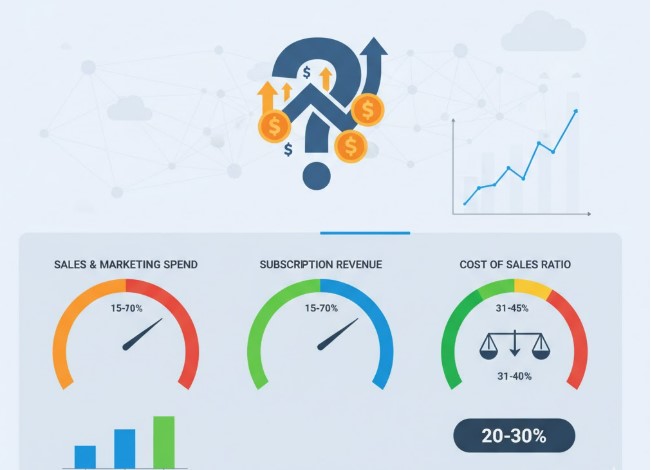
Have you ever wondered why some SaaS companies scale rapidly while others struggle to stay profitable? The answer often lies in one crucial metric — the Cost of Sales (COS). In simple terms, this figure tells you how much it costs to sell your software and deliver it to customers. Yet, understanding what is a reasonable cost of sales for SaaS product can be tricky, especially with variables like hosting costs, support, and software licenses constantly shifting.
In the fast-evolving SaaS landscape, knowing your COS isn’t just an accounting task — it’s a strategic advantage. Generally, a reasonable cost of sales for a SaaS product falls between 15% and 30% of total revenue. But why does this range matter, and how can you stay within it? Let’s dive into the layers of this concept and explore what truly makes a SaaS business financially healthy.
Why Cost of Sales Matters for Every SaaS Business
The Cost of Sales (COS) isn’t just a line on a balance sheet — it’s the financial pulse of your SaaS operation. Every dollar you spend delivering your product impacts your profit margins and long-term sustainability. If your COS runs too high, you might be growing your revenue but losing profitability. If it’s too low, you risk underinvesting in quality and customer support.
For SaaS businesses, the COS typically includes direct expenses like:
- Hosting and server costs
- Cloud infrastructure (AWS, Azure, or Google Cloud)
- Support and customer success team salaries
- Software licenses and third-party integrations
- Payment processing and data storage fees
Think of your Cost of Sales as the “fuel” that powers your SaaS engine. Managing it effectively helps ensure that growth doesn’t come at the expense of stability.
Breaking Down the Components of SaaS Cost of Sales
Understanding what goes into the cost of sales is the first step toward managing it wisely. In SaaS, the COS includes both direct and indirect costs, each playing a unique role in how you deliver your service.
Direct Costs: The Core of Product Delivery
These are the expenses directly tied to creating and maintaining your SaaS product. Common examples include:
- Server hosting and cloud storage fees
- Customer support salaries
- Software licenses
- Security and compliance tools
These costs ensure that your product runs smoothly and reliably for users. If your servers fail or support falters, customers will churn quickly — making these investments non-negotiable.
Indirect Costs: The Supportive Framework
Indirect costs, while not directly linked to delivery, still impact your ability to sell and support your product. Examples include:
- Marketing campaign expenses
- Administrative salaries
- Sales commissions and CRM tools
Both direct and indirect costs must be analyzed together to get a full picture of your SaaS Cost of Sales. Striking the right balance helps prevent overspending while maintaining service quality.
The Relationship Between Cost of Sales and Profitability
The beauty of SaaS lies in scalability — once your product is built, each new customer adds minimal incremental cost. However, that doesn’t mean your COS automatically shrinks over time. Factors like cloud usage, customer support demands, and software integrations can cause expenses to rise unexpectedly.
To understand profitability, many SaaS companies rely on key metrics such as:
- Gross Margin = (Revenue – Cost of Sales) / Revenue
- Customer Lifetime Value (CLV)
- LTV:CAC Ratio (Lifetime Value to Customer Acquisition Cost)
A SaaS business with a gross margin above 70% is generally considered healthy. If your margins fall below 60%, it’s a warning sign that your Cost of Sales may be too high — or your pricing strategy too low.
Key Factors That Influence the Cost of Sales
Not all SaaS businesses are created equal. The Cost of Sales can vary widely depending on your product type, target audience, and business stage. Here are the main elements that shape it:
1. Customer Acquisition Costs (CAC)
This includes everything you spend to gain a new customer — ads, sales commissions, and onboarding efforts. A higher CAC inflates your COS, so optimizing marketing efficiency is essential.
2. Infrastructure and Technology Costs
Cloud-based hosting, bandwidth, and third-party API usage can eat into your margins quickly. Choosing scalable, pay-as-you-go services can help control these costs.
3. Support and Retention
Customer support is one of the largest ongoing expenses in SaaS. However, efficient support not only retains customers but also reduces churn — indirectly lowering your long-term COS.
4. Product Complexity
The more complex your product, the more resources you’ll need to support, update, and maintain it. Simpler SaaS products tend to have lower COS ratios.
5. Pricing and Monetization Model
Subscription tiers, freemium models, and discounts can all impact how much revenue you earn relative to your COS. Always ensure your pricing reflects the value you deliver and the costs you incur.
How to Calculate a Reasonable Cost of Sales for SaaS

Calculating your Cost of Sales doesn’t need to be complicated. It simply involves identifying all costs tied directly to creating and delivering your product — then expressing that as a percentage of total revenue.
Here’s a simple formula:
Cost of Sales (%) = (Total Direct Costs / Total Revenue) × 100
Example:
| Item | Monthly Cost (USD) |
|---|---|
| Hosting and Cloud Services | $15,000 |
| Customer Support Team | $10,000 |
| Software Licenses | $5,000 |
| Payment Processing Fees | $2,000 |
| Total Direct Costs | $32,000 |
| Total Revenue | $120,000 |
| Cost of Sales (%) | 26.6% |
In this example, the Cost of Sales sits comfortably within the 15–30% range — meaning the company’s spending is efficient and sustainable.
The Benchmark: What Is a “Good” Cost of Sales for SaaS?
There’s no universal rule for all SaaS businesses, but most successful companies maintain a Cost of Sales between 15% and 30% of total revenue.
- Early-stage SaaS startups often face higher COS (30–40%) as they invest heavily in product development and infrastructure.
- Mature SaaS companies with optimized operations usually maintain a COS around 15–20%.
Here’s a general benchmark table for clarity:
| SaaS Stage | Typical COS Range | Key Priorities |
|---|---|---|
| Startup (0–2 years) | 30–40% | Building infrastructure and acquiring users |
| Growth Stage (2–5 years) | 20–30% | Scaling customer base and improving efficiency |
| Established SaaS | 15–20% | Sustaining profitability and expanding features |
Remember, these percentages aren’t just numbers. They reflect your company’s operational maturity and ability to scale efficiently.
Direct Costs vs. Indirect Costs: The Balance That Defines Profit
Many SaaS founders make the mistake of underestimating indirect costs, assuming only direct expenses affect profitability. But in reality, indirect costs can quietly drain resources if not managed strategically.
Here’s how they differ:
| Cost Type | Description | Examples |
|---|---|---|
| Direct Costs | Directly tied to creating and delivering your SaaS product. | Hosting, software licenses, customer support salaries |
| Indirect Costs | Support operational efficiency but not tied directly to delivery. | Marketing, sales team salaries, administrative costs |
Balancing these costs is vital. For instance, investing slightly more in customer support (a direct cost) can reduce churn and improve retention — ultimately lowering your Cost of Sales over time.
Optimizing Your Cost of Sales: The Smart Way to Scale
Once you’ve calculated your COS, the next step is optimization. The goal isn’t just to cut costs but to spend smarter. In SaaS, optimization often revolves around three key areas: acquisition efficiency, customer retention, and technology utilization.
1. Improve Efficiency in Customer Acquisition
One of the biggest drivers of COS is how much you spend to acquire new customers. Focus on:
- Targeted marketing campaigns that reach your ideal customer profile (ICP)
- Automation tools for lead generation and follow-ups
- Data analytics to track which channels bring the highest ROI
For example, if your paid ads bring expensive leads but organic search brings high-value customers at a lower cost, shifting budget focus can reduce your overall COS.
2. Reduce Customer Churn
Customer churn silently inflates your Cost of Sales by forcing you to replace lost revenue. To reduce churn:
- Offer responsive and personalized customer support
- Continuously improve product performance
- Launch retention programs or loyalty discounts
Every customer you retain effectively reduces your COS over time because you don’t have to spend to reacquire them.
3. Leverage Technology for Cost Savings
Automation is the secret weapon of modern SaaS cost management. From AI-powered chatbots to automated onboarding flows, technology can streamline operations, reduce manual work, and lower support costs.
Common tools that help reduce COS include:
- CRM automation software for better lead management
- Cloud optimization platforms for efficient resource use
- Self-service portals that reduce support volume
When technology and strategy align, SaaS businesses achieve scalable growth without ballooning expenses.
Benchmarking and Comparing SaaS Cost of Sales
Benchmarking helps you understand whether your Cost of Sales is within a healthy range or if it’s overshooting industry norms. Every SaaS business is unique, but comparing your numbers with competitors gives you a clear reference point for improvement.
Industry Standards and Averages
Most SaaS companies maintain their Cost of Sales between 15% and 30% of total revenue. This range accounts for all direct expenses related to product delivery and customer support.
- Low-cost SaaS tools (like productivity apps or simple CRM software) usually have COS closer to 15–20%.
- Enterprise SaaS platforms (requiring dedicated support and complex integrations) may sit around 25–30%.
Benchmarking allows companies to align their cost structures with peers while maintaining profitability. However, it’s crucial not to copy another company’s model blindly — your pricing, audience, and growth stage might require different spending levels.
Identifying Deviations and Variations
Every deviation from the benchmark tells a story. For example:
- If your COS is too high, you might be overspending on infrastructure, support, or inefficient sales processes.
- If it’s too low, you could be underinvesting in quality, risking customer churn and poor user experience.
Here’s a quick breakdown of factors that commonly cause deviations:
- Business Model: A self-service SaaS tool (like Trello or Notion) generally has a lower COS than an enterprise-level platform that needs onboarding and dedicated account managers.
- Growth Stage: Startups spend more on infrastructure and marketing, while established players benefit from economies of scale.
- Competitive Landscape: If your market is saturated, expect higher marketing and acquisition costs.
Understanding these variations helps you fine-tune your strategy and keep your Cost of Sales aligned with long-term goals.
Effective Strategies to Manage and Control Cost of Sales
Keeping your Cost of Sales reasonable doesn’t mean cutting corners — it’s about strategic management. You need to invest in the right areas while ensuring that every dollar spent contributes to growth and customer satisfaction.
Let’s explore some proven ways to keep your COS healthy and sustainable.
1. Invest in Employee Training and Development
Your sales and customer success teams are at the frontline of revenue generation. A well-trained team can convert leads faster, reduce support time, and improve customer satisfaction — all of which lower your COS.
Provide continuous training on:
- Product knowledge and demo delivery
- Objection handling
- Customer empathy and communication skills
- CRM tool usage and automation techniques
By empowering employees with the right skills, SaaS companies can reduce inefficiencies and enhance sales productivity without increasing costs.
2. Negotiate Better Vendor and Supplier Contracts
Vendor costs — such as cloud storage, API access, or third-party integrations — form a big chunk of SaaS expenses. Regularly renegotiating contracts can lead to significant savings.
Here are some negotiation tips:
- Commit to longer contracts for volume discounts
- Explore multi-cloud options to avoid vendor lock-in
- Regularly audit your subscription services to remove unused tools
Even a 5% reduction in vendor costs can noticeably improve your Cost of Sales margin.
3. Implement Scalable Sales and Support Processes
As your user base grows, you’ll need scalable processes that don’t increase expenses linearly. This is where automation and process optimization become essential.
- Use AI-driven sales tools to automate lead qualification
- Implement self-service support portals for common issues
- Standardize onboarding templates and FAQ libraries
Scalability means your costs grow slower than your revenue — exactly what a healthy SaaS business model demands.
Measuring the Effectiveness of Your Cost of Sales
Knowing your Cost of Sales is just step one; understanding how it impacts your company’s performance is where the real insight lies. COS directly affects profitability, growth potential, and cash flow.
Impact on Profit Margins
Profit margin is the ultimate indicator of financial health. If your COS eats into more than 30% of revenue, you may struggle to achieve a sustainable gross margin.
Most successful SaaS firms maintain:
- Gross margins of 70–85% for strong profitability
- Operating margins of 20–30% after accounting for all expenses
A reasonable Cost of Sales ensures that you can reinvest profits into R&D, customer retention, and marketing without risking financial instability.
Relationship to Revenue Growth
The Cost of Sales doesn’t just affect current profits — it determines how much room you have to grow. A company with a lower COS can allocate more capital toward marketing and innovation.
For example:
- Lower COS → More investment in feature development → Higher customer satisfaction → Increased renewals and referrals.
In essence, maintaining a healthy COS creates a growth loop that fuels both profitability and expansion.
Adapting Your Cost of Sales Strategy to SaaS Market Realities
The SaaS industry evolves fast, and what worked last year may not be as effective today. Adapting your Cost of Sales strategy ensures that your spending aligns with market shifts and customer expectations.
Understanding Subscription-Based Models
Unlike traditional businesses, SaaS relies heavily on recurring revenue. This means your Cost of Sales must be viewed across the customer lifecycle — not just at acquisition.
Each customer contributes revenue monthly or annually, so the real question becomes: How long does it take for a customer to cover their acquisition and service costs?
If your payback period (the time to recover CAC) exceeds 12 months, it’s a signal to re-evaluate your pricing, support costs, or sales approach.
Handling Seasonal Demand Fluctuations
Some SaaS companies experience seasonal usage patterns — for example, accounting software peaks during tax season.
To manage this:
- Scale cloud resources dynamically (use auto-scaling features)
- Hire temporary support staff during busy months
- Adjust marketing spend based on seasonality trends
Smart adaptation ensures that your COS remains balanced throughout the year.
Forecasting and Predicting Future Cost of Sales
Managing today’s costs is important, but forecasting tomorrow’s COS is what keeps your SaaS business prepared for growth and market changes.
Using Data Analytics for Forecasting
Predictive analytics allows SaaS companies to anticipate how changes in operations will affect future COS.
For instance, by analyzing historical data, you can predict how scaling to 10,000 users will influence your hosting and support costs.
Key analytics tools can help track:
- Cloud utilization trends
- Churn patterns
- Customer support ticket volume
Data-backed insights make financial planning more accurate and prevent unpleasant surprises.
Adapting to Market and Industry Changes
Your COS should never stay static. New technologies, pricing models, and customer expectations will continuously reshape your expenses.
Regularly reviewing your Cost of Sales every quarter ensures that you adapt quickly to:
- Market price shifts (like increased cloud costs)
- Competitor pricing pressures
- Economic fluctuations
Agility in cost management is what keeps top SaaS players ahead of the curve.
FAQs About What is a Reasonable Cost of Sales for SaaS Product
1. What is the average cost of sales for SaaS?
The average cost of sales for SaaS products generally falls between 15% and 30% of total revenue. This includes hosting, customer support, and delivery expenses. Startups might see higher ratios initially as they scale operations.
2. What does COGS mean in SaaS?
In SaaS, COGS (Cost of Goods Sold) refers to all direct expenses tied to creating and delivering the product — such as cloud hosting, third-party licenses, and customer service salaries. It’s another way to measure Cost of Sales.
3. What’s the difference between COS and CAC?
Cost of Sales (COS) includes the total cost of delivering your product, while Customer Acquisition Cost (CAC) focuses only on how much you spend to gain new customers. Both are vital for measuring profitability.
4. What is a good profit margin for a SaaS product?
A good profit margin for SaaS typically ranges between 60% and 80%. High-margin businesses maintain low COS by using automation, efficient infrastructure, and strong retention strategies.
5. How can I reduce my SaaS cost of sales?
You can reduce your COS by:
- Automating repetitive sales and support tasks
- Negotiating better vendor rates
- Reducing churn through better onboarding
- Using scalable infrastructure
The key is to lower costs without hurting customer experience.
6. Why does the cost of sales vary by SaaS type?
Different SaaS products require different levels of support and infrastructure. A simple mobile SaaS app will have a lower COS compared to a complex enterprise-level solution that demands 24/7 customer success teams.
7. How often should SaaS companies review their cost of sales?
Ideally, review your COS quarterly. This helps you respond quickly to operational changes, cost increases, or shifts in customer behavior before they impact profitability.
Conclusion: Striking the Perfect Balance
So, what is a reasonable cost of sales for SaaS product? The answer lies not in a fixed number, but in balance. A COS between 15% and 30% of revenue is considered healthy, but the true benchmark depends on your business model, growth stage, and efficiency.
Understanding your COS gives you control. It helps you price your services correctly, allocate resources wisely, and maintain profitability while scaling.
The most successful SaaS companies aren’t those with the lowest costs — they’re the ones who know where and when to spend for maximum impact.
In the end, managing your Cost of Sales isn’t just about saving money — it’s about building a sustainable, scalable SaaS business that thrives in a competitive digital world.
