

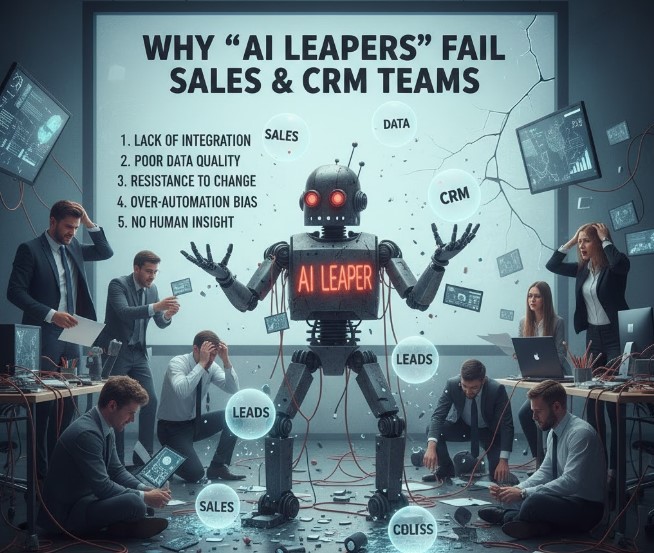
“AI Leapers” often fail sales and CRM teams because they implement AI solutions without understanding team needs, proper training, or a clear strategy, leading to frustration and wasted resources instead of improved performance.
Key Takeaways
- Understand team needs before AI adoption.
- Provide thorough AI training for sales staff.
- Develop a clear AI implementation strategy.
- Measure AI impact on sales and CRM.
- Integrate AI smoothly into existing workflows.
- Focus on human-AI collaboration for success.
The buzz around Artificial Intelligence (AI) in sales and customer relationship management (CRM) is undeniable. Many companies are eager to “leap” into AI, hoping for a magical boost in efficiency and revenue. But what happens when this leap doesn’t land them where they expected? You might be hearing about “AI leapers” who, despite their enthusiasm, find their sales and CRM teams struggling. If you’re wondering why this happens and how to avoid it, you’ve come to the right place. We’ll break down the common pitfalls and show you how to make AI a true asset, not a burden, for your team.
Understanding the “AI Leaper” Phenomenon
An “AI leaper” is a team or company that eagerly adopts new AI technologies, often driven by a desire to stay ahead of the curve or capitalize on perceived immediate benefits. They might invest heavily in AI-powered CRM tools, predictive analytics, or sales automation platforms. The intention is usually to streamline processes, gain deeper customer insights, and boost sales performance. However, the execution can often fall short, leading to disappointment and underperformance.
Think of it like buying a top-of-the-line sports car but never learning how to drive it properly. You have the powerful engine and sleek design, but without the right skills and guidance, it’s more likely to cause a fender-bender than win a race. Similarly, AI tools, no matter how advanced, require a strategic approach and user understanding to deliver their promised value.
Why AI Leapers Often Fall Short in Sales & CRM
Several common reasons explain why companies enthusiastically adopting AI for sales and CRM end up facing challenges. These aren’t necessarily due to faulty technology, but rather how it’s introduced and managed.
1. Lack of Clear Strategy and Goals
One of the biggest mistakes “AI leapers” make is adopting AI tools without a clear understanding of what they want to achieve. They might see competitors using AI and jump on board without defining specific, measurable, achievable, relevant, and time-bound (SMART) goals. This can lead to a scattershot approach where AI is implemented for its own sake, rather than to solve a particular problem or improve a specific metric.
For example, a sales team might implement an AI chatbot for customer service without a plan to integrate its data into their CRM or train the bot on company-specific product knowledge. The result? A disconnected tool that doesn’t truly enhance the customer experience or provide valuable sales insights.
2. Ignoring Team Needs and Existing Workflows
AI tools are most effective when they augment, not disrupt, the daily work of sales and CRM professionals. Many “AI leapers” fail to involve their teams in the selection and implementation process. They might choose a tool based on flashy features or vendor promises, without considering how it will actually fit into the team’s existing workflows, or whether it addresses their actual pain points.
When an AI solution feels alien or adds extra steps to a salesperson’s already busy day, adoption rates plummet. Instead of seeing AI as a helpful assistant, team members might view it as an unnecessary complication or even a threat to their jobs. According to a report by Forbes, employee resistance is a major factor in AI implementation failures.
3. Insufficient Training and Skill Development
AI technology, even when designed to be user-friendly, requires some level of training and skill development. “AI leapers” often underestimate the training needed, assuming team members will simply “figure it out.” This is a critical oversight. Sales and CRM professionals need to understand not just how to operate the AI tool, but also how to interpret its outputs, leverage its insights, and integrate it effectively into their sales process.
Without proper training, AI tools can be underutilized or misused. For example, a predictive lead scoring tool might generate scores, but if the sales team doesn’t understand the factors influencing those scores or how to act on them differently, the tool’s potential remains untapped. Effective training empowers users and builds confidence in the technology.
4. Over-reliance on Automation, Under-reliance on Human Insight
AI excels at automating repetitive tasks and analyzing vast amounts of data. However, sales and customer relationships are fundamentally human endeavors. Many “AI leapers” fall into the trap of over-automating, believing that AI can replace the nuanced judgment and empathy that human sales professionals bring. This is particularly true when AI is used for customer interactions.
While an AI chatbot can handle initial inquiries or routine questions, complex sales negotiations, building rapport, and understanding subtle customer cues often require human intuition and emotional intelligence. When companies rely too heavily on AI to manage customer relationships, they risk creating impersonal experiences that alienate customers and damage long-term loyalty. Research from institutions like Harvard Business Review emphasizes the importance of balancing AI with human touch.
5. Poor Data Quality and Integration Issues
AI algorithms are only as good as the data they are trained on and the data they have access to. If a company’s CRM data is incomplete, inaccurate, or siloed, the AI tools that rely on this data will produce unreliable insights and recommendations. “AI leapers” sometimes overlook the critical importance of data hygiene and integration.
For AI to be effective in sales and CRM, data needs to be clean, consistent, and accessible. This means ensuring accurate contact information, tracking customer interactions consistently, and integrating data from various sources (e.g., marketing automation, customer support, sales calls) into the CRM system. Without this foundation, AI-powered insights will be flawed, leading to poor decision-making.
6. Unrealistic Expectations and Lack of Patience
Implementing AI is not an overnight fix. It’s a process that requires time for integration, training, adaptation, and optimization. “AI leapers” often expect immediate, dramatic results, and when these aren’t seen, they become discouraged and may abandon the AI initiatives prematurely. The complexities of data migration, system integration, and cultural change take time to navigate.
For instance, an AI tool designed to predict customer churn might take time to collect enough data and refine its algorithms to provide accurate predictions. If the team expects perfect predictions from day one, they’ll likely be disappointed. Patience and a phased approach are key to realizing AI’s long-term benefits.
The Consequences of Failed AI Adoption
When “AI leapers” fail to implement AI effectively, the consequences can be significant and far-reaching:
- Wasted Investment: Significant financial resources are spent on AI software, implementation services, and training that yield little to no return.
- Decreased Team Morale: Frustration arises from tools that don’t work as expected, add to workloads, or seem to be implemented without regard for the team’s input.
- Missed Opportunities: Instead of gaining a competitive edge, companies may fall behind as they struggle with poorly implemented technology.
- Damaged Customer Relationships: Impersonal or ineffective AI interactions can lead to customer dissatisfaction and churn.
- Erosion of Trust: If AI initiatives fail repeatedly, both employees and leadership can lose faith in the potential of technology to improve business outcomes.
How to Successfully Implement AI in Sales & CRM: A Step-by-Step Guide
Avoiding the pitfalls of “AI leapers” requires a thoughtful and strategic approach. Here’s how you can ensure AI becomes a success for your sales and CRM teams:
Step 1: Define Clear, Measurable Goals
Before you even look at AI tools, ask yourself: What specific problems are we trying to solve? What outcomes do we want to achieve?
- Examples: Increase lead conversion rates by 15% in six months, reduce customer support response time by 30%, improve sales forecast accuracy by 20%.
- Action: Document these goals. They will guide your AI selection and measure your success.
Step 2: Assess Your Team’s Needs and Readiness
Involve your sales and CRM teams from the outset. Understand their current challenges, workflows, and skill sets. What tasks consume the most time? Where do they feel they need support?
- Action: Conduct surveys, hold focus groups, and have one-on-one conversations. This ensures buy-in and helps identify the most suitable AI applications.
Step 3: Prioritize Data Quality and Integration
AI thrives on good data. Ensure your CRM data is clean, accurate, and comprehensive. Identify any gaps and implement processes for data enrichment and standardization.
- Action: Invest in data cleansing tools or services. Establish clear data entry protocols. Plan how the new AI tool will integrate with your existing CRM and other relevant systems.
Step 4: Choose the Right AI Tools Wisely
Based on your goals and team needs, research and select AI tools that offer the right functionality. Don’t get swayed by hype; focus on tools that demonstrably solve your identified problems.
- Considerations:
- Ease of integration
- User-friendliness
- Vendor support and training resources
- Scalability
- Security features
- Action: Request demos, run pilot programs with a small group, and check reviews and case studies from reputable sources.
Here’s a quick comparison of common AI applications in sales and CRM:
| AI Application | Purpose | Potential Benefits | Key Considerations for Implementation |
|---|---|---|---|
| AI-Powered CRM | Automates data entry, provides customer insights, predicts sales trends. | Increased efficiency, better lead qualification, improved customer segmentation. | Data accuracy, user adoption, integration with other tools. |
| Predictive Analytics | Forecasts sales, identifies high-potential leads, predicts customer churn. | More accurate forecasting, proactive customer retention, optimized sales efforts. | Quality of historical data, clarity of predictive models, actionability of insights. |
| AI Chatbots | Handles customer inquiries, qualifies leads, provides instant support. | 24/7 availability, reduced support costs, faster query resolution. | Natural language processing capabilities, integration with knowledge base, seamless escalation to human agents. |
| Sales Automation Tools | Automates repetitive tasks like email outreach, scheduling, and follow-ups. | Increased productivity, consistent sales communication, more time for selling. | Customization options, ability to personalize messages, integration with CRM. |
Step 5: Provide Comprehensive Training and Ongoing Support
This is non-negotiable. Equip your team with the knowledge and skills to use the AI tools effectively.
- Training Content: Cover tool functionality, interpretation of AI-generated insights, best practices for integration into daily tasks, and ethical considerations.
- Support: Establish clear channels for ongoing support, troubleshooting, and continuous learning.
Pro Tip: Implement a “train-the-trainer” program where power users become internal champions and assist their colleagues, fostering a collaborative learning environment.
Step 6: Start Small and Scale Gradually
Don’t try to implement everything at once. Begin with a pilot program or a single AI tool that addresses a pressing need.
- Action: Roll out the AI solution to a small, receptive team first. Gather feedback, refine the process, and then scale to the wider organization. This phased approach minimizes disruption and allows for course correction.
Step 7: Monitor, Measure, and Iterate
Continuously track the performance of your AI tools against the goals you set in Step 1. What’s working? What’s not? Where can improvements be made?
- Key Metrics: Conversion rates, customer satisfaction scores (CSAT), sales cycle length, forecast accuracy, user adoption rates.
- Action: Regularly review performance data and solicit feedback from your team. Be prepared to adjust your strategy, retrain users, or even switch tools if necessary. According to Statista, AI adoption is growing globally, but success hinges on continuous adaptation.
Step 8: Foster Human-AI Collaboration
Emphasize that AI is a tool to augment human capabilities, not replace them. Encourage your teams to see AI as a partner that can handle data-heavy tasks, allowing them to focus on the more strategic, relationship-building aspects of sales and CRM.
- Focus: Train your teams on how to leverage AI insights for more personalized customer interactions, better negotiation strategies, and more empathetic problem-solving.
Case Study Snippet: Success Story
Acme Corp, a mid-sized SaaS company, initially struggled with lead management, missing key follow-up opportunities. They identified a need for better lead scoring and automated outreach. Instead of jumping on the latest AI trend, they:
- Defined a goal to increase qualified leads by 20%.
- Surveyed their sales team about bottlenecks in lead handling.
- Ensured their CRM data was clean and consistent.
- Selected an AI-powered lead scoring and nurturing platform that integrated seamlessly with their existing CRM.
- Provided comprehensive training on how to interpret lead scores and personalize outreach based on AI-driven insights.
Within six months, Acme Corp saw a 25% increase in qualified leads and a 15% improvement in conversion rates. Their sales team reported feeling more productive and less overwhelmed, actively using the AI insights to guide their conversations.
Frequently Asked Questions (FAQs)
Q1: What is the biggest mistake companies make when adopting AI for sales and CRM?
A1: The biggest mistake is often implementing AI without a clear strategy or understanding of how it fits into the team’s daily workflow and existing processes. Insufficient training is also a major pitfall.
Q2: How can I ensure my sales team will actually use the new AI tools?
A2: Involve your team in the selection process, choose tools that solve their problems, provide thorough and ongoing training, and clearly demonstrate how the AI will make their jobs easier and more effective.
Q3: Do I need highly technical staff to manage AI in sales and CRM?
A3: Not necessarily. Many modern AI tools are designed for user-friendliness. While some technical oversight might be needed for integration or advanced customization, the focus should be on ensuring your sales and CRM professionals can readily use the tools for their day-to-day tasks.
Q4: How much does AI for sales and CRM typically cost?
A4: Costs vary widely. Basic AI features might be included in existing CRM subscriptions. Standalone AI tools can range from a few dollars to several hundred or even thousands of dollars per user per month, depending on features and scale.
Q5: How can I measure the success of AI implementation in my sales team?
A5: Measure key performance indicators (KPIs) related to your initial goals. This could include lead conversion rates, sales cycle length, customer satisfaction scores, forecast accuracy, and user adoption rates of the AI tools.
Q6: Is it better to build custom AI solutions or buy off-the-shelf AI tools?
A6: For most small to medium-sized businesses, buying off-the-shelf AI tools is more practical and cost-effective. Custom solutions require significant investment in development and expertise. Off-the-shelf solutions are faster to implement and often come with vendor support.
Conclusion
The allure of AI for sales and CRM is strong, promising enhanced efficiency and revenue growth. However, the journey is fraught with potential pitfalls for “AI leapers” who rush in without a plan. By understanding the common reasons for failure—lack of strategy, ignoring team needs, insufficient training, over-reliance on automation, poor data, and unrealistic expectations—you can chart a course for success.
Focusing on clear goals, deep team involvement, robust data practices, comprehensive training, and a commitment to human-AI collaboration will transform AI from a daunting technological leap into a powerful, integrated asset for your sales and CRM teams. Remember, the goal isn’t just to adopt AI, but to leverage it intelligently to empower your people and drive sustainable business growth.
