

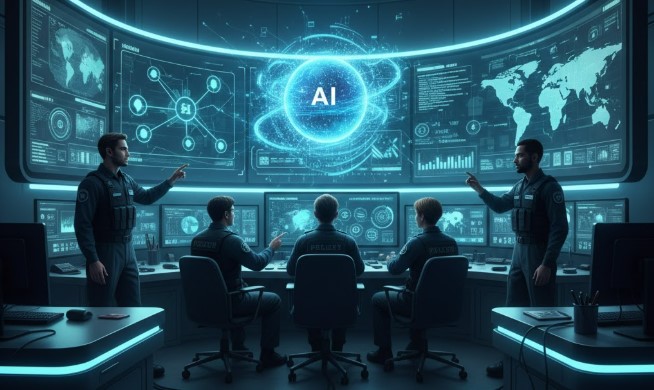
AI is revolutionizing cybersecurity by acting as a powerful force multiplier for security teams, enabling them to combat threats more efficiently with limited resources. This guide explains how AI empowers security professionals.
Key Takeaways
- AI automates repetitive security tasks.
- It enhances threat detection speed and accuracy.
- AI helps analyze vast security data sets.
- It supports security teams with limited staff.
- AI enables proactive threat hunting.
- It improves incident response times significantly.
Introduction
Are you curious about how Artificial Intelligence (AI) is changing the game for cybersecurity professionals? In today’s fast-paced digital world, security teams are often stretched thin, facing an ever-growing volume and sophistication of cyber threats. It can feel overwhelming to keep up. But what if there was a way to amplify the effectiveness of your security team, even with limited resources? That’s where AI steps in. This article demystifies how AI becomes a powerful force multiplier for security teams, making them smarter, faster, and more resilient. Let’s explore how AI is transforming the cybersecurity landscape and what it means for you.
What Does It Mean for AI to Be a Force Multiplier?
In military terms, a force multiplier is something that significantly increases the combat power of a unit or force. It allows a smaller, less equipped force to achieve the effects of a much larger one. Applied to cybersecurity, AI acts as a force multiplier by augmenting the capabilities of human security teams. It doesn’t replace human analysts but rather enhances their abilities, allowing them to handle more tasks, detect threats faster, and make more informed decisions.
Think of it like this: A skilled archer is good, but a skilled archer with a high-powered telescope and a computer that predicts wind patterns is exponentially better. The telescope and computer don’t replace the archer’s skill; they amplify it. Similarly, AI tools provide security teams with enhanced vision, processing power, and predictive capabilities, allowing them to defend digital assets more effectively than ever before.
Why AI is Crucial for Today’s Security Teams
The landscape of cyber threats is evolving at an unprecedented rate. Attackers are becoming more sophisticated, using advanced techniques to breach defenses. Simultaneously, the amount of data generated daily is exploding, making it nearly impossible for human analysts to sift through it all manually.
According to Statista, the global data sphere was projected to grow to 175 zettabytes by 2025. This sheer volume of information includes logs, network traffic, threat intelligence feeds, and more – all potential indicators of a security incident. Human teams can only process so much. AI’s ability to process and analyze this data at speeds far beyond human capacity is what makes it indispensable. It helps bridge the gap between the growing threat landscape and the often-limited resources available to security departments.
Furthermore, there’s a significant cybersecurity workforce shortage. A report by (ISC)² in 2021 indicated a gap of about 2.7 million cybersecurity professionals worldwide. AI can help alleviate the pressure on these understaffed teams by automating routine tasks and prioritizing alerts, allowing human experts to focus on more complex threats and strategic initiatives.
How AI Acts as a Force Multiplier for Security Teams
AI enhances security operations in several key ways, directly translating to increased effectiveness and efficiency for security teams.
1. Enhanced Threat Detection and Faster Response
One of the most significant benefits of AI in cybersecurity is its ability to detect threats much faster and more accurately than traditional methods. AI algorithms can analyze patterns in real-time, identifying anomalies that might indicate malicious activity. This includes detecting zero-day exploits – new, previously unknown threats – which signature-based detection systems often miss.
Machine learning, a subset of AI, is particularly useful here. It can learn from vast datasets of normal network behavior and flag deviations quickly. When a potential threat is identified, AI can also automate initial response actions, such as isolating an infected device or blocking malicious IP addresses. This reduces the time attackers have to operate within a network, minimizing potential damage. The U.S. Department of Homeland Security highlights how AI can improve the speed and effectiveness of threat detection and response across critical infrastructure.
2. Automating Repetitive and Time-Consuming Tasks
Security analysts often spend a significant portion of their day on repetitive tasks like sifting through logs, categorizing alerts, and performing initial investigations. AI can automate many of these mundane but critical duties.
For instance, AI-powered Security Information and Event Management (SIEM) systems can automatically collect and correlate security data from various sources. They can also identify false positives – security alerts that turn out to be harmless – saving analysts valuable time. By offloading these tasks to AI, security teams can focus on higher-level analysis, strategic planning, and proactive threat hunting, rather than being bogged down by manual processes.
3. Advanced Data Analysis and Predictive Capabilities
The sheer volume of security data is overwhelming. AI, particularly machine learning and natural language processing (NLP), excels at analyzing these massive datasets to uncover subtle patterns, trends, and correlations that human analysts might miss. This deep analysis can reveal hidden threats or vulnerabilities.
Moreover, AI can use historical data to predict future attack vectors or identify emerging threats before they become widespread. This proactive approach allows security teams to strengthen their defenses in anticipation of new attack methods. For example, AI can analyze global threat intelligence feeds to identify regions or industries that are becoming prime targets, enabling preventative measures.
4. Improved Threat Hunting
Threat hunting is a proactive security practice where analysts search for threats that have bypassed existing defenses. AI enhances threat hunting by providing analysts with tools that can sift through vast amounts of data, highlight suspicious activities, and even suggest areas to investigate. AI can help identify campaign-like activities or attacker tactics, techniques, and procedures (TTPs) that might otherwise remain undetected.
AI-driven platforms can automate the process of collecting and correlating diverse data points – from endpoint logs and network traffic to user behavior analytics. This allows human threat hunters to focus their expertise on investigating the most critical leads identified by AI, making their efforts more targeted and effective.
5. Streamlining Incident Response
When a security incident occurs, swift and effective action is paramount. AI can significantly streamline the incident response process. AI tools can help in:
- Automated Triage: Quickly assessing the severity and scope of an incident.
- Root Cause Analysis: Helping to identify how an attack originated.
- Automated Remediation: Triggering predefined actions to contain and neutralize threats.
- Generating Reports: Assisting in the creation of post-incident reports for documentation and learning.
By automating these steps, AI reduces the time to detect, contain, and recover from security breaches, minimizing downtime and financial losses for an organization. The Harvard Business Review has discussed how AI can speed up the decision-making process during high-pressure incident response scenarios.
Examples of AI in Action for Security Teams
Let’s look at some concrete examples of how AI is being used:
User and Entity Behavior Analytics (UEBA)
UEBA systems use AI to establish baseline behavior patterns for users and devices within a network. When a user’s activity deviates significantly from their normal pattern – for example, logging in at unusual hours from an unfamiliar location, or accessing sensitive files they don’t normally interact with – the AI flags it as potentially suspicious. This helps detect insider threats or compromised accounts.
Network Traffic Analysis (NTA)
AI-powered NTA tools monitor network traffic for anomalies. They can identify unusual data flows, suspicious communication patterns, or signs of malware communication that traditional firewalls might miss. This is crucial for detecting lateral movement by attackers within a network.
Endpoint Detection and Response (EDR)
Modern EDR solutions leverage AI to monitor endpoints (laptops, servers, etc.) for malicious activity. They can detect sophisticated malware, ransomware, and fileless attacks that evade traditional antivirus software by analyzing behaviors and process interactions in real-time.
Security Orchestration, Automation, and Response (SOAR)
SOAR platforms integrate various security tools and automate workflows. AI plays a role in intelligent alert prioritization and in automating responses based on learned patterns and predefined playbooks. This makes the overall security operations center (SOC) more efficient.
AI vs. Traditional Security Methods
It’s helpful to see how AI complements and surpasses traditional security approaches.
| Feature | Traditional Security Methods | AI-Powered Security |
|---|---|---|
| Threat Detection | Primarily signature-based, reactive to known threats. Can miss new or polymorphic malware. | Behavioral analysis, anomaly detection, machine learning. Can detect zero-day threats and sophisticated attacks. |
| Data Analysis | Manual review of logs and alerts. Limited by human capacity. | Automated analysis of massive datasets, identifying subtle patterns and correlations. |
| Response Time | Slower, reliant on human analysts to investigate and act. | Faster, with automated responses and prioritized alerts, reducing dwell time. |
| Scalability | Struggles with increasing data volumes and threat complexity. | Scales effectively to handle large volumes of data and evolving threats. |
| Workload | High manual workload, prone to analyst fatigue and burnout. | Automates routine tasks, freeing up analysts for strategic work. |
Implementation Challenges and Considerations
While the benefits of AI in cybersecurity are clear, implementing these technologies isn’t without its challenges:
- Data Quality and Quantity: AI models need high-quality, relevant data to learn effectively. Insufficient or biased data can lead to inaccurate predictions or responses.
- Complexity and Skill Gap: Managing and interpreting AI tools requires specialized skills, which may be lacking in some security teams.
- Cost: Advanced AI security solutions can be expensive to acquire and implement.
- False Positives/Negatives: AI systems are not perfect. They can still generate false alarms (alerting on benign activity) or miss actual threats (false negatives). Continuous tuning and human oversight are essential.
- Integration with Existing Systems: Ensuring new AI tools work seamlessly with existing security infrastructure can be complex.
The National Institute of Standards and Technology (NIST) provides guidance on AI security, emphasizing the need for robust testing and validation of AI systems.
Pro Tips for Leveraging AI as a Force Multiplier
To maximize the impact of AI on your security team, consider these practical tips:
- Start with a Clear Goal: Identify a specific problem or inefficiency AI can address, rather than implementing it broadly.
- Focus on Automation of Repetitive Tasks: Use AI first to free up your analysts from mundane jobs.
- Invest in Training: Ensure your team has the necessary skills to operate and interpret AI tools.
- Maintain Human Oversight: AI should augment, not replace, human analysts. Ensure critical decisions are always reviewed by a human expert.
- Continuously Monitor and Tune: AI models need regular updates and adjustments to remain effective against evolving threats.
- Begin with Smaller, Manageable Deployments: Test AI solutions in a controlled environment before scaling them across the entire organization.
The Future of AI and Security Teams
The role of AI in cybersecurity is only set to grow. We can expect AI to become even more sophisticated, enabling more autonomous security systems. This will likely lead to:
- Hyper-automation: More complex security processes will be fully automated.
- Advanced Predictive Analytics: AI will get better at foreseeing future attacks and vulnerabilities.
- AI-Powered Defense Against AI Attacks: As attackers use AI, defenders will increasingly rely on AI to counter these novel threats.
- Democratization of Advanced Security: AI could make sophisticated security capabilities more accessible to smaller organizations that cannot afford large security teams.
Organizations that embrace AI will be better positioned to defend against the threats of tomorrow. It’s not just about having more tools; it’s about having smarter tools that amplify human ingenuity and expertise.
Frequently Asked Questions (FAQ)
What is the primary benefit of AI for security teams?
The primary benefit is acting as a force multiplier, significantly increasing efficiency and effectiveness by automating tasks, enhancing threat detection, and speeding up response times, especially for understaffed teams.
Can AI replace human security analysts?
No, AI is designed to augment human capabilities, not replace them. It handles repetitive tasks and data analysis, allowing human analysts to focus on complex problem-solving, strategy, and critical decision-making.
How does AI improve threat detection?
AI uses machine learning to analyze vast amounts of data in real-time, identifying anomalies and patterns that indicate unknown or zero-day threats that traditional signature-based methods might miss.
What are some common AI tools used in cybersecurity?
Common tools include User and Entity Behavior Analytics (UEBA), Network Traffic Analysis (NTA), Endpoint Detection and Response (EDR), and Security Orchestration, Automation, and Response (SOAR) platforms that incorporate AI capabilities.
Is AI expensive to implement for security teams?
The cost can vary greatly. While advanced AI solutions can be a significant investment, many cloud-based AI security services offer more accessible options, and the return on investment through increased efficiency and reduced breach costs can be substantial.
What is the biggest challenge in adopting AI for security?
Key challenges include ensuring high-quality data for AI training, the need for skilled personnel to manage AI tools, and the ongoing complexity of integrating AI with existing security infrastructures.
Conclusion
AI is no longer a futuristic concept in cybersecurity; it’s a present-day reality and a critical component of modern defense strategies. By acting as a force multiplier, AI empowers security teams to be more agile, efficient, and effective in the face of increasingly complex cyber threats. From automating routine tasks and enhancing threat detection to providing deeper analytical insights and streamlining incident response, AI equips security professionals with the tools they need to protect digital assets more robustly. Embracing AI is not just about staying ahead of adversaries; it’s about optimizing the invaluable expertise of human security teams and ensuring they can meet the demands of an ever-evolving digital landscape.
